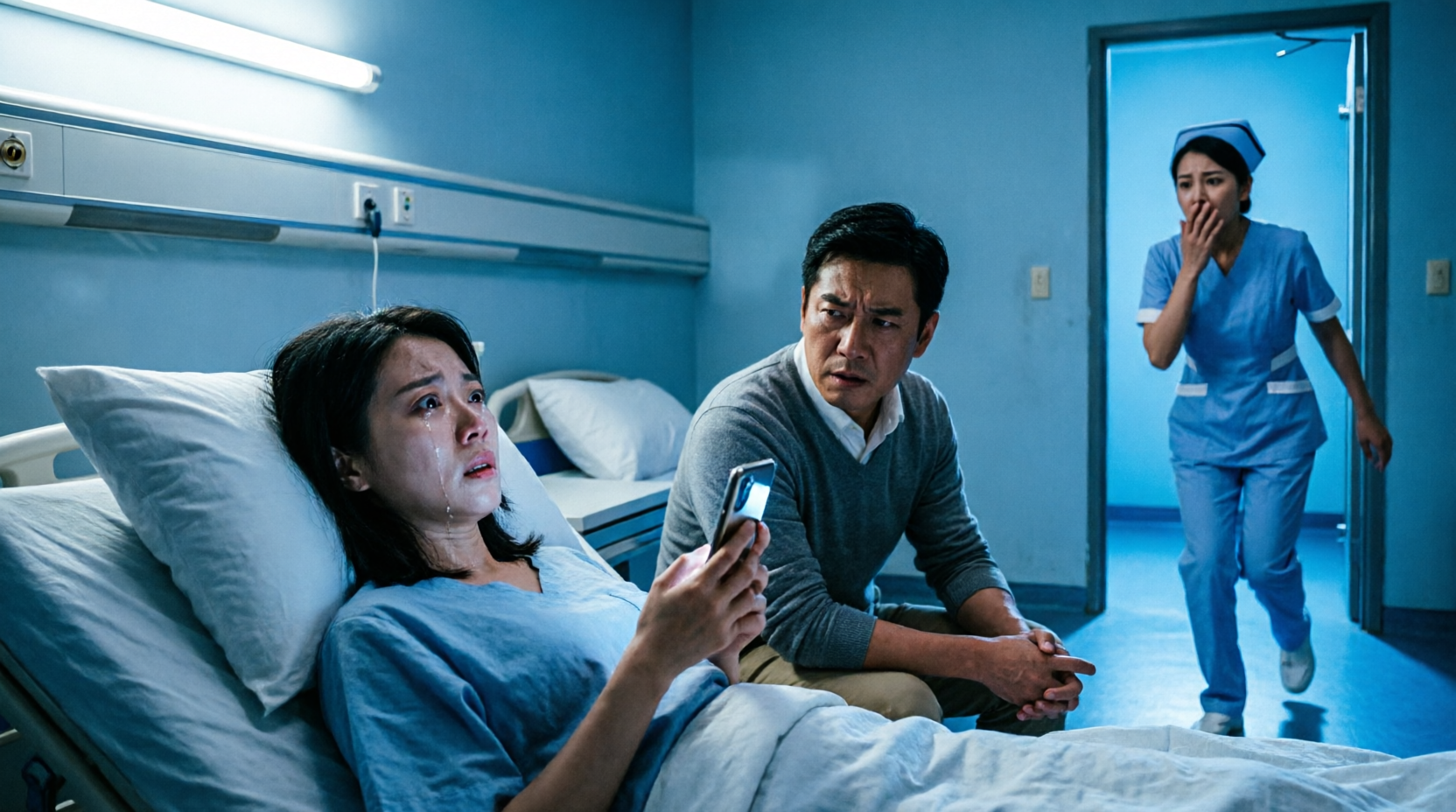
Before my surgery, my husband texted: “I want a divorce. I don’t need a sick wife”; the patient in the next bed comforted me; “If I survive this, we should get married,” I said; he nodded; a nurse gasped: “Any idea who you just asked?”
The city bus lurched over a pothole, and Jessica clutched the bag on her knees.
It was a reflex, as if she were carrying something fragile. In truth, she was carrying almost nothing: a change of underwear, a toothbrush, a book she probably would not open, and a small bag of apples. The nurse on the phone had told her fruit was allowed. It seemed absurdly small for where she was going—for surgery, for anesthesia, for the possibility of not waking up.
She looked out the window.
Arbor Hill in late November passed by in gray layers she knew by heart. Bare linden trees lined Main Street. Puddles had frozen overnight and were already cracking apart by noon. There was the smell of wood smoke from the houses farther out, and the warm yeasty scent of bread from the bakery on the corner. Jessica had been born in this town. She had grown up here. She had taught at the elementary school for ten years. She knew every crack in the sidewalk, every sagging fence, every backyard swing set, every narrow alley behind the old brick storefronts.
And yet, looking out the window now, the whole place felt like a quiet farewell.
Not dramatic. Not theatrical. Just silent and steady.
What if this was the last time?
The surgeon had been an honest man. He had not frightened her, but he had not offered the soft lies people give when they cannot bear the truth.
“The tumor is benign,” he had said, “but an operation is still an operation. Risks exist. Anesthesia. Postoperative complications.”
He had looked her directly in the eye when he said it, and she respected him for that. Even so, in that moment she had wished with all her heart that he had lied just a little.
When the truth of it settled—not in her head, but somewhere much deeper—her first thought had not been Evan, her husband of eight years.
She thought of her second graders.
She thought of Ben, who had finally learned to read without stumbling over every third word. She thought of Paige, with her forever-untied shoelaces and sharp little tongue. She thought of Dany, who had cried at the classroom door the first week of September and now ran into the room every morning like he owned it.
She thought of who would explain verb tenses to them.
Who would wait for Dany at the door.
Who would remind Paige to tie her shoes before recess.
That said a lot about her marriage.
It probably said everything.
She had married Evan Morris when she was twenty-four. Back then he was one of those men who filled a room without seeming to try. Loud laugh. Broad gestures. Total confidence. The kind of energy younger women often mistake for substance.
Her mother, Carmen, a seamstress with tired hands and thirty years of other people’s hems and alterations behind her, had said quietly one night while pinning a dress at the kitchen table,
“Be careful, Jessica. Loud men are often only loud on the outside.”
Jessica had not listened.
She had thought her mother simply did not know how to be happy for someone else.
The happiness lasted about a year and a half.
After that, nothing was openly terrible, and that was the trap of it. There were no screaming matches. No bruises. No single story she could tell a friend and immediately earn full sympathy.
It was something quieter.
His armchair always somehow ended up in the center of the living room, claiming the space. Her things shifted toward the edges. Her books on the bottom shelf. Her jacket on the wall hook closest to the plaster. Her weekend plans always became the less important plans without anyone ever formally discussing it.
It simply happened.
They never had children.
Every year Evan had a new reason.
“It’s not the right time.”
“We don’t have enough money.”
“You’re still young.”
At first she believed him. Then she stopped believing him, but kept waiting anyway. After a while, waiting stopped being a temporary state and became the backdrop of her life.
In the last two years he had started coming home late.
“Work,” he would say.
“Meetings. Clients.”
She stopped asking questions. Not because she was brave enough for the answer. Not because she was afraid of it either, though there was some of that. Mostly she stopped because she had forgotten how to demand one.
It happens slowly.
One evening you decide not to bring something up because you are tired.
Another evening because you do not want an argument.
And one day you look up and realize you have not asked for anything real in a very long time.
When she came home three weeks earlier with the test results and told him she needed urgent surgery, Evan had looked up from his phone, listened for ten seconds, and said,
“So get the surgery. It’s scheduled, not life or death.”
Then he looked back down at the screen.
She had gone to the consultation alone.
Listened alone. Signed the forms alone. Packed her bag alone.
That morning she had called a cab to get to the bus stop because Evan had already left for what he called an important meeting. She did not cry. She had not cried over him in a long time. She had simply picked up the bag and gone.
The clinic stood in the center of town, a three-story building from the seventies that had been modernized on the outside with clean siding and new windows, though the inside still smelled of linoleum, bleach, fluorescent light, and old time.
Jessica checked in at the front desk, handed over her papers, and received a room number.
The nurse at the desk was an older woman with a kind, tired face. Jessica’s badge said Brenda Sanchez. She was scanning the forms when she suddenly paused.
“Jessica Davis,” she said, with a small apologetic wince. “There’s one issue. We don’t have any private rooms available right now.”
Jessica waited.
“You’ll be in a double room. There’s already a patient there. A man. But he’s very…” Brenda searched for the word. “Quiet.”
Jessica looked at her.
“Okay,” she said.
What else was there to say?
Brenda let out a breath, visibly relieved, then handed her a folded gown and the rest of the paperwork.
The room was on the second floor at the end of the hall. Two beds. Two nightstands. One window overlooking the little courtyard where a bench sat beside a wild rose bush stripped of leaves, with only the dark red rose hips still holding on to the branches.
The bed near the door was empty and made up for her.
In the other, near the window, a man was reading.
Not a phone. Not a tablet.
A real paper book with a worn spine.
He looked up when she entered. Mid-forties, maybe. Dark hair touched with gray at the temples. A composed face. Not cold. Serene. His gaze was direct, but not invasive. He looked at her naturally, like a person who had long ago outgrown awkward performances.
“Morning,” he said.
“Morning,” she replied.
She set her bag down, unpacked quietly, and changed.
They introduced themselves. He was Mark Grant. She was Jessica.
Nothing more followed, and that felt right.
There was no forced small talk. No clumsy filling of silence. He went back to his book, and she sat on her bed staring up at the ceiling. It was ordinary enough—white paint, one faint crack near the window that looked like a river on a map.
Tomorrow morning, she thought. Tomorrow morning they’ll take me in. They’ll put the mask over my face and tell me to count.
The fear was physical. It sat under her ribs and climbed sometimes to her throat.
Outside, darkness came early. November did that. The rose hips darkened almost to black as the courtyard faded into shadow.
She did not sleep that night.
That was no surprise. She had been sleeping badly for weeks, waking at three or four in the morning with a nameless anxiety. Now the anxiety had a date.
Tomorrow at eight a.m., the operating table.
The room was silent. Every so often headlights passed outside and brushed pale light across the ceiling.
Mark lay in his bed by the window. Judging by his breathing, he was not asleep either. It was too even. Too deliberate.
“Scared?” he asked into the darkness.
His voice was low. Not really a question. More like a gentle recognition of the obvious.
Jessica stayed quiet for a second.
“Yes,” she said.
Silence.
Then he said, “I was scared too. Three years ago. When I was really sick.”
He did not explain what kind of sick. Jessica did not ask.
In the dark hospital room, the content mattered less than the fact of it. He had said it out loud. He had not pretended fear was weakness. He had not reached for the usual nonsense.
Did it pass?
She asked it softly.
“It passed,” he said.
Nothing more.
Jessica closed her eyes. She still did not sleep, but the fear changed shape. It did not go away. It simply seemed less sharp, as if someone had split it with her.
The feeling was strange.
Next to her was almost a stranger. They had exchanged maybe five real sentences all afternoon, and yet she felt less alone than she had felt in years beside the man who shared her last name.
She did not want to think about what that meant.
She lay there and listened as the first snow of the season began to fall. You could not see it in the darkness, but you could hear the city go soft beneath it. Sounds muffled. Padded. Wrapped.
In the morning, her phone woke her.
Not a call.
A text.
It had come during one of those shallow stretches of half-sleep that are not rest but only exhaustion pausing for breath. She picked up the phone automatically, expecting maybe her mother. Carmen knew nothing about the operation. Jessica had not told her, not wanting to worry her.
But the name on the screen was Evan.
She read it.
We’re getting a divorce. I don’t need you, especially not when you’re sick. I’m not giving you money for the surgery. You have your insurance. My lawyer is already drawing up the papers. Don’t call.
She read it again.
And again.
The words did not change.
Eight years.
Eight years of getting up first. Eight years of keeping the apartment running, paying the mortgage, sometimes paying more when he was short. Eight years of waiting for children he kept postponing until the delay itself became the answer.
Eight years of saying to herself,
It’s okay. It’ll work out. It just takes time.
And now, the morning of her surgery, while she lay in a hospital bed with a bag of apples and no one beside her, he ended it by text and wrote:
Don’t call.
She did not realize she was crying until the screen blurred in her hand.
Then something inside her gave way completely, and the tears came harder. Her shoulders shook. She pressed the phone against her chest and bent over, not from pain but from something that had no clean name. Eight years hitting all at once. The fact that he had not even called. The fact that in two hours she would be wheeled into surgery, and the only thing the person closest to her had given her was rejection.
Mark did not move immediately.
He gave her a moment. Probably because he knew that rushing kindness can feel like another intrusion.
Then he sat up, took a glass of water from his nightstand, and placed it beside her bed. He sat in the chair, not on the bed. In the chair. Close enough to help, far enough not to cross a line.
“What happened?” he asked quietly.
She could not speak. She held the phone out to him.
He took it, read the message, and handed it back. His face was unreadable, not because he did not care, but because he did. The restraint itself said that.
Only his jaw tightened slightly.
“Can you postpone the surgery?” he asked.
“I can’t.”
The words scraped out of her throat.
“The doctor said I can’t wait. The tumor is small now, but the rate of growth…”
Her voice trailed off.
Mark nodded.
Then he sat there beside her and said nothing.
And that turned out to matter more than almost anything else. He did not tell her everything would be fine. He did not offer platitudes. He did not ask nosy questions. He was simply there. Present.
An orderly came in a few minutes later for his own pre-op preparation.
“Mark Grant,” she said briskly. “Be ready in twenty minutes.”
He stood and took his jacket from the nightstand.
Jessica was still sitting on the bed. The tears had mostly stopped, but she still had that strange hollow feeling that comes after crying hard—everything washed clean and empty at the same time.
She looked at him. Tall. Quiet. The worn paper book on the nightstand beside his bed.
And suddenly, without planning it, without even really believing herself, she heard bitterness twist into something like a laugh.
“You’re so decent,” she said. “Not like my husband. If I survive this, we should get married.”
She expected a smile.
Or a gentle joke.
Or one of those smart, compassionate answers people use to meet a bitter joke halfway without embarrassing the person who made it.
He stopped.
He looked at her, not for a second but longer than that.
Seriously.
Then he nodded.
“Okay.”
The orderly was already steering the gurney into the hallway. Mark walked out. The door closed.
Jessica stared at the door.
She was almost certain he had only played along. Almost certain it was his way of saying, Hold on. You’ll get through this.
Almost.
At eight o’clock sharp, they came for her.
Another nurse, younger, quicker, with a flashy manicure—Nicole Campos, according to her badge—checked the bracelet on Jessica’s wrist and said,
“Let’s go.”
The gurney rolled down the hall.
Jessica lay on her back staring at the ceiling as the fluorescent panels passed above her one after another. A corner. Double doors. Another corridor. The operating room smelled of cold air, steel, and sterile focus.
Dr. Louis Herrera, the older lean surgeon she had met during the consultation, was already there. Soft voice. Absolutely steady hands.
He looked at her and said,
“It’s going to be okay, Jessica.”
The anesthesiologist brought the mask down.
“Breathe deep. Count if you want.”
Jessica closed her eyes.
She did not count.
Her last thought, already fading before everything went white and then black, was of the wild rose bush outside the hospital room window and the dark red hips still clinging to bare branches.
If I wake up, she thought, the first thing I’ll do is look at that window.
Darkness came gently.
She woke to pain.
Not sharp pain. A deep, dull ache, as if something important inside her had been moved and had not yet settled back into place. Jessica opened her eyes and saw a white ceiling.
Not the operating room ceiling.
The crack near the window.
Her room.
That was how she knew first: she had woken up.
For a few seconds she simply lay there breathing. Inhale. Exhale. It hurt, but the hurt was good. It was the pain of a living person.
Brenda appeared almost at once, as if she had been waiting nearby.
“You’re back with us, Jessica. Wonderful.”
She adjusted the IV, checked the chart, then smiled again.
“The surgery was a success. Dr. Herrera did a flawless job. The tumor was completely removed.”
She hesitated just slightly, then added in a quieter tone, almost privately,
“Your reproductive organs were preserved.”
Jessica closed her eyes.
After I’m alive, came the second thing.
You can still have children.
Relief moved through her in a warm wave from her chest to her fingertips. She did not cry. She simply breathed and let the truth move through her.
Then came the next question.
And now what?
The text had not vanished. It was still there. In her phone. In her body. In the entire wreckage of the last eight years.
She turned her head toward the next bed.
They had brought Mark back earlier. His procedure had been shorter. He lay there looking out at the gray November sky. When her gurney rolled into the room, he turned.
“How are you?” he asked.
“Alive.”
“Good.”
It was a small word, but it was real. Not polite. Real.
The first day she slept most of the time. The anesthesia wore off reluctantly, leaving behind thick drowsiness and an unreal, floating feeling.
Mark did not bother her.
Sometimes when she opened her eyes, he was looking out the window. Sometimes he had his eyes closed. Sometimes he was reading that same worn paper book. He was present without noise, without performance, without that suffocating helpfulness that is often more about the helper than the person in pain.
In the evening they brought her broth.
She ate half and stopped.
“You still have half left,” Mark said from behind his book.
It was an observation, not a command.
“I know,” she said.
“I can tell the difference,” he replied.
She finished it.
The next day Nicole Campos came in again. Jessica remembered her immediately—the same nurse who had taken her to the operating room.
This time Nicole entered with the brisk, slightly unpleasant energy of someone doing a task she did not enjoy.
She stopped at Jessica’s bed, checked the chart, then said,
“Your husband called. He said he’s going by the apartment to pick up some of his things, and that you shouldn’t try to contact him.”
Jessica looked at her.
“Okay,” she said.
Nicole lingered for a heartbeat, almost as if she had expected another reaction, then turned and left.
Silence settled again.
Then Mark lowered his book.
“You know your husband,” he said.
It was not a question.
Jessica stared at the ceiling. Evan had been to this clinic about a month earlier. She remembered that now. He had said it was for work, something involving a medical equipment supplier. Two trips, he’d mentioned. She had not cared enough to ask details at the time.
Now the pieces clicked into place too easily.
“I guess so,” she said.
Mark asked nothing more.
That, too, was the right thing to do.
Brenda came in around noon during her usual rounds. Injections. Blood pressure. Notes on the chart. She was careful, precise, the kind of nurse who probably had not made a serious mistake in thirty years and never would.
Jessica had already begun to trust her.
Brenda gave the injection, put the syringe away, and then, very unexpectedly, paused. She looked at Jessica, then cast a quick, guilty glance toward Mark’s bed, and then back at Jessica.
“Jessica,” she began cautiously, “do you know who’s in your room?”
Jessica frowned and looked toward the other bed.
“Mr. Grant,” she said. “Mark Grant.”
Brenda lowered her voice to a near-whisper, though it was useless in a room that small.
“You don’t understand. He’s that Mr. Grant. The one with commercial real estate in seven states, the tech company in Austin, and who knows what else in Chicago. One of the wealthiest men in the region.”
“People usually say New York,” came Mark’s voice calmly from the bed by the window.
Brenda froze.
Mark lowered the book to his lap and looked at her—not angrily, simply directly.
“Thank you,” he said. “That was a very comprehensive report.”
Brenda blushed hard, muttered something to herself, gathered her tray, and escaped.
Jessica turned to Mark.
“You heard that?”
“Yes.”
“And?”
“And nothing.” He turned the page. “It’s just information.”
That evening, when the hall quieted and the room fell into that gentle hospital twilight that invites honesty, Jessica asked the question that had been building inside her all day.
“Why are you here? In this clinic. In this town.”
“You mean, couldn’t I have gone somewhere else?”
“Yes.”
He nodded.
“Dr. Herrera is the best surgeon in the country for adhesions. He left New York years ago and refuses to go back. If you want the best result, you come here.”
She hesitated.
“And the double room?”
“There were no private rooms.”
“A man in your position could have waited. Or negotiated.”
Mark was quiet a little longer than usual.
“I don’t like being alone,” he said.
The sentence was neutral, but something in it told her how rarely he said it aloud.
“Alone in hotels. Alone in the car. Alone at home. At least here there’s another living person nearby.”
He turned slightly toward the window again.
Jessica did not answer.
Some truths do not ask for a reply.
On the third day, it was she who returned to the subject hanging between them.
“Mark.”
He looked up.
“Do you remember what I said before surgery? About getting married?”
“Yes.”
“Were you serious?”
He set the book down and met her gaze without any trace of mockery.
“Yes,” he said.
“You’re crazy.”
“It’s possible.”
Jessica stared at him.
“I’m not ready. I’m still married. I’m half-recovering from anesthesia. I know almost nothing about you except that you read paper books and don’t like being alone.”
“I know.”
He said it calmly.
“I’m not in a hurry.”
It was precisely that which disarmed her. No push. No persuasion. No subtle demand hidden inside tenderness.
I’m not in a hurry.
Suddenly, after years of being cornered by passivity and pressure in different forms, she felt something unfamiliar.
Time.
Choice.
The days in the room settled into a strange rhythm.
The first two days she was allowed to do almost nothing except get help to the bathroom. Humiliating, but not more humiliating than illness always is. Then she was allowed to sit up. Then to walk slowly around the room.
The pain receded by degrees. Sometimes it seemed nearly gone; then it returned in a dull wave.
Mark recovered faster. His surgery had been simpler. By the third day he was already walking the hall with that steady, unhurried pace of his. Sometimes he brought tea from the vending machine and left it on her nightstand without ceremony.
A silent pact formed between them not to turn ordinary kindness into a production.
Jessica told him about her students. Not because she had nothing else to say, but because teaching was the shape of her life.
She told him about Ben, who now brought books from home with such pride you’d think he had written them himself.
About Paige, who always somehow said exactly what everyone else was thinking but no one dared to say.
About Dany, who in September cried every morning and by November was passionately arguing over whether dinosaurs were stronger than robots.
Mark listened in a way she had never seen an adult listen. No phone. No polite mask. No waiting for her to finish so he could speak. He listened as if the content mattered.
In eight years, Evan had never once asked the name of a single one of her students.
The comparison came on its own.
It is not money, she thought. It is not charm. It is not status.
It is that one person looked at me when I spoke, and the other never really did.
He told her about Vera on the fourth night.
Not all at once. Gradually.
He had lived in New York. He had been married. Vera was a painter. Quiet, he said. And in that one word there was so much warmth Jessica understood that quiet was not an adjective but a whole love story.
Vera had died in her eighth month of pregnancy. Acute toxemia. They had not gotten there in time.
He said it plainly. No drama. No performance. Just fact.
But it was exactly that plainness that tightened Jessica’s throat.
“Eleven years,” he said. “Just work, money, and an empty apartment. I learned how to live in silence. I never learned how to like it.”
Jessica did not say, “I’m sorry.”
She simply reached her hand across the space between the beds and took his for a few seconds.
Then she let go.
He looked down at his own wrist as if he could still feel her touch there.
He said nothing, but something in him changed. Subtly. Like light changing in a room when a cloud moves away.
On the sixth day, Dr. Herrera examined them both. Few words, as always. He listened, checked the incision, reviewed the results, and declared Jessica ready for discharge. One week of IV treatment done. No lifting more than two pounds. Daily dressing changes. Follow-up in a month.
Mark was discharged the same day.
“So,” Jessica said when the surgeon left. “That’s a coincidence.”
“It is,” Mark said.
“Did you drive here?”
“Yes.”
A pause.
“I have to take you home,” he added. “You can’t carry your bag on the bus.”
She was about to protest. Then she pictured the jolting bus, the standing passengers, the poles she’d have to grip, the bag she was not supposed to lift.
“Okay,” she said.
The next morning they packed almost at the same time.
Jessica folded her clothes carefully into the small bag. The apples were mostly untouched. The book remained unread. Mark lifted a black canvas duffel, equally plain.
At the door she stopped and looked back.
Two beds. Two nightstands. The window. The rosebush in the courtyard. Overnight a clean layer of first snow had covered everything. The red rose hips glowed through it like tiny lanterns.
She had woken up. She had looked out that window.
Promise kept.
His car waited in the parking lot. Dark, expensive, but not flashy. The kind of money that does not need to shout.
He opened the passenger door for her, waited until she was settled, and put the bag in the back.
Arbor Hill was white under snow. The first real snow always made the town look slightly unreal, as if someone had erased everything unnecessary and left only the outlines.
Jessica looked out the window and thought, I’m alive. It’s snowing. I’m going home.
The word home sounded strange.
What waited for her was an apartment with a hole where a person had been.
Mark drove quietly. He asked once which turn to take. She pointed.
He pulled up in front of her building, an old five-story walk-up with her apartment on the third floor. Jessica looked at the stairs and felt something sink inside her.
“I’ll carry it,” Mark said, already reaching for the bag.
They climbed slowly.
She opened the door.
The apartment greeted them with silence and that peculiar smell homes have when something has recently been removed. His armchair was still there, but the corner by the television was different. The floor lamp was gone. His jacket no longer hung on the rack in the entryway. In the kitchen, the mug he always used was missing from the bottom shelf. The framed fishing photo from three years ago was gone too, leaving a little cleaner rectangle on the wall.
It was not the objects themselves. It was the absence of habit.
Jessica stood in the middle of the living room and felt the emptiness like temperature.
Mark put her bag down, looked once around the room, went to the kitchen, opened the fridge, then closed it again.
“I’m going to buy food,” he said.
“You don’t have to.”
“You can’t lift anything for two weeks.”
He said it not like a benefactor, but as someone stating a medical fact.
Then he left before she could protest.
Jessica sat down carefully on the sofa. The incision complained at any sudden movement. She looked at the corner where the lamp used to be and sat in the quiet until the light outside turned thin and blue.
Mark returned forty minutes later with grocery bags. Chicken. Vegetables. Bread. Things she did not even bother inventorying.
He put them away with calm efficiency, set a pot on the stove, and started making soup.
“You know how to make soup?” she asked.
“I learned,” he said. “When you’re alone, you either learn or you live on takeout.”
It was obvious he did not live on takeout.
The smell of chicken broth slowly filled the apartment. Warm. Living. Human.
Jessica sat on the sofa and watched through the kitchen doorway as a man she barely knew stirred soup in her pot as if it were the most natural thing in the world.
A tear slid down her cheek.
Not because of Evan.
Not because of the text.
Not because of the empty corner.
Simply because someone had come into her cold apartment and made her soup.
She wiped her face quickly and turned toward the window. Outside, darkness had settled. The first snow lay smooth over everything, like a blank page.
There would be time later for the divorce, the papers, the apartment, the job, all the exhausting practical things still waiting for her.
For now there was soup.
And a man who was in no hurry and asked for nothing.
He left that night, saying only that he was staying at a hotel.
At the door he paused.
“How will you be tomorrow?”
“Fine. I’ll manage.”
“I’ll stop by in the morning,” he said.
Not asking.
Telling.
Then he looked at her.
“Jessica. Remember our deal?”
She held his gaze.
“I remember.”
He nodded once and left.
She stood with her back against the closed door afterward, listening to the quiet apartment.
Eight years, she thought, ended with a text message.
And something new had begun with a nod in a hospital room and the smell of chicken broth in a nearly empty apartment.
The next morning he arrived at eight-thirty.
Jessica had been awake since seven. Morning pain was always sharper. She opened the door carefully, one hand against her side more from habit than necessity.
Mark stood there with a grocery bag and two cardboard coffee cups.
“No elevator,” he said. “I remember.”
He went into the kitchen, set the bag down, placed one coffee in front of her, and sat opposite her at the table.
“How did you sleep?”
“Badly.”
“Normal. Mornings hurt more. That should ease by the end of the week.”
“You took notes on Herrera’s instructions?”
“I listen carefully when something matters.”
He was looking out the window when he said it, as if sitting in her kitchen at eight-thirty on a gray December morning were completely ordinary.
“You don’t have to come every day,” she said.
“I know.”
“Then why?”
He turned to her.
“Because you can’t lift anything and groceries don’t buy themselves.”
A pause.
“And because this apartment is very quiet now. I know what that’s like.”
He came every morning after that.
He did not move in. That mattered. He stayed at a hotel she never saw, though the details he let slip suggested it was a very nice one. He never discussed it. He simply came from there and left back there each evening.
He brought food. Cooked simple things. Soup. Rice with chicken breast. Boiled eggs with short practical notes left in the fridge.
Two eggs. Bread in bread box. One tomato left.
Jessica laughed at those notes quietly to herself. Then she would stop and think how long it had been since something as small as that had made her laugh.
On the fourth day she realized she was waiting for him.
Not in the feverish way people wait for desire. Just in the simple way a mind begins measuring time toward the sound of a doorbell.
That realization frightened her.
She was still married.
Her recovery was unfinished. The divorce had not even properly begun. She had no energy to analyze what this was, so she forced herself toward other thoughts. School. Her class. Whether Dany was still arguing about dinosaurs and robots. Whether Paige still had her shoelaces untied.
She called Nadia, a colleague from school, and asked if she could bring over the class notebooks for grading.
Nadia arrived that same day with the notebooks, a container of hot food, and so much school gossip that Jessica spent an hour laughing and hardly noticed the pain.
Mark arrived just as Nadia was leaving.
They passed each other at the door.
A minute later Jessica’s phone buzzed.
Who is that? Nadia texted.
Jessica replied: Hospital roommate.
Nadia’s answer came back almost immediately.
I see.
Jessica put the phone down and pretended not to understand everything contained in those two words.
On the fifth day Evan called.
Jessica was sitting by the window with the book she had taken to the hospital and never opened there. His number flashed on the screen. For eight years, that number had meant husband. Now it meant something else for which she had not yet found a word.
She answered.
“Jessica.”
His tone was already arranged. He sounded like a man who had assigned roles before the conversation began.
“I need you to sign the papers for the condo.”
“What papers?”
“The voluntary waiver of your share. My lawyer has it ready. I can bring it by today.”
Jessica stared out at the courtyard, the swings under snow, the gray winter sky.
“No,” she said.
A beat of silence.
He had not expected that.
“Jessica, don’t make this difficult.”
Not rude. Just that tone. The one that said he was about to tell her how things were.
“I bought the condo. I made the down payment.”
“You made the down payment,” she said. “We both paid the mortgage for eight years. I have the receipts.”
Silence again.
“That won’t change anything,” he said, and now the coldness beneath the control showed itself. “I have a good lawyer. And I have proof that after the surgery you weren’t in a condition to make decisions.”
Jessica sat very still.
“What does that mean?”
“It means that if necessary, I can prove you were incapacitated. For example, when you were making certain decisions about… meeting people.”
A pause.
“Think about it. You’ll only make trouble for yourself. Text me when you’ve decided.”
The line went dead.
Jessica lowered the phone slowly.
The white courtyard outside did not move.
Incapacitated.
Meeting people.
Then she understood.
He meant Mark. He meant the hospital. The bitter joke. The nod. The fact that, within days of surgery, a man was coming to her apartment every day. All of it could be woven into a story. Not a true story. A usable one.
Mark arrived two hours later and saw at once that something had happened.
She told him everything word for word.
Her voice surprised her. It was neutral. Not numb. Controlled.
When she finished, he was silent for a moment.
“He doesn’t just want the condo,” he said.
“I know that.”
“No,” he said, looking at her directly. “Listen. If a judge declares you incapacitated during that period, it doesn’t only affect one decision. It casts doubt on all your legal capacity after surgery. Your ability to defend your interests. Any agreement you made. Any choice.”
Jessica frowned.
“How do you know how this works?”
“I’ve been in business a long time,” he said. “It’s an old tactic. Not new. Not particularly clever. But it works if you don’t stop it early.”
“You need a lawyer,” he added.
“Lawyers cost money.”
“Yes.”
A pause.
Jessica looked at him.
“No,” she said.
He blinked once.
“You don’t even know what I’m going to offer.”
“I know.”
“You were going to offer me your lawyer, or pay for one, or structure it some other way. But you were going to pay, and I can’t accept that.”
“Why?”
“Because I don’t know what I’d be paying you back with,” she said quietly. “And I’m used to nothing being free.”
He was quiet for a few seconds.
Then he said, very evenly,
“I’m not Evan.”
Three words.
Jessica exhaled.
“I know,” she said. “But eight years teach caution.”
“Fair enough.”
No offense. No wounded pride. Just acceptance.
“Okay,” he said. “Then do it this way. Lawrence Bell. Best family lawyer in the region. I’ll give you the number. You call him yourself. You arrange payment yourself. I won’t be involved.”
He paused.
“If you need help later, you tell me.”
That was all.
Jessica turned to the window. The same courtyard. The same winter light.
Eight years of being accommodating had gotten her nowhere.
“Give me the number,” she said.
Lawrence Bell came to the apartment two days later.
Mid-fifties. Heavyset. Slow movements, quick eyes. He sat at her kitchen table, asked for coffee, and said,
“Tell me.”
So she did.
He listened without taking notes at first, interrupting only to clarify dates, amounts, names on contracts. Then he opened his briefcase and spread out papers.
“As to the condo,” he said, “your position is strong. If the payments came from your account or were equally split, it’s provable. You have all eight years of receipts?”
“Yes.”
He lifted an eyebrow very slightly, as if eight years of receipts were rarer than decency itself.
“Excellent. As for the incapacity claim, it’s weak—but not something to ignore. We’ll need Herrera’s report confirming a normal operation and standard recovery. We’ll need confirmation that the prescribed medication did not impair consciousness. Standard procedure.”
He rubbed the bridge of his nose.
“And we’ll need your resolve in court.”
“I have it,” Jessica said.
He nodded.
“Good. Then we begin.”
Mark had sat quietly by the wall the entire time, saying nothing.
When Lawrence packed his briefcase and left, Jessica turned back toward the room and said,
“You paid him.”
It was not a question.
“Lawrence doesn’t make house calls,” Mark said. “He sees clients in his office. I asked him to come because you shouldn’t be going up and down stairs right now.”
“That’s all?”
“That’s all.”
She looked at him.
“You do everything methodically.”
“Do you object?”
“No,” she said after a moment. “I’m just not used to it.”
“I know.”
He took his jacket from the chair.
“Get used to it,” he said, and left.
Three days later Evan called again.
This time Jessica was ready.
He started talking about the condo, about signatures, about how much easier everything would be if she stopped being emotional.
“Evan,” she interrupted. “I have a lawyer. From now on, all communication goes through him.”
She gave him Lawrence Bell’s name.
Silence.
A different kind of silence than before.
He knew the name.
“Jessica…” he began, in a noticeably more careful voice.
“Through the lawyer,” she repeated, and ended the call.
Afterward she sat very still for a moment, then got up and put the kettle on.
Outside, December had turned darker, flatter, inevitable. No longer the pretty first snow. Just the long season settling in.
It’s not fear anymore, she realized. It’s work.
That feeling was new.
That night, as Mark was putting on his coat to leave, she stopped him.
“Mark.”
He turned.
“Were you serious in the hospital? Not about the soup or the lawyer. About what you said.”
“Yes.”
“We’ve known each other less than a month.”
“I know.”
“You know about me what I told you in the room and what your lawyer could have found in five minutes.”
“Less than you think,” he said. “I didn’t ask him to look up anything.”
She crossed her arms.
“This is called a fling.”
“It’s possible.”
“You don’t seem like the type who has flings.”
“I don’t,” he said. “That’s why when I do something, I prefer to mean it.”
Outside, wind pushed thin snow against the window.
“Give me time,” she said.
“How much?”
“I don’t know.”
“That’s okay,” he said. “I’ll wait.”
He said it so naturally that she believed him at once. Not because he had nothing else to do, but because he had decided.
And when Mark Grant decided something, it felt less like intention and more like fact.
The next morning she met him at the door with a different decision.
“I need a notary,” she said. “Lawrence says I should document that the mortgage payments came from my account.”
“Yes.”
“And one more thing.”
He waited.
“You suggested I move in with you while the legal process is going on. So I wouldn’t be alone.”
He said nothing.
“I’ve thought about it,” she went on. “Okay.”
He did not answer at once.
He looked at her for a few seconds, and on his face was the expression people get when they receive something they had nearly stopped hoping for. Not triumph. Just quiet relief.
“Okay,” he said.
The notary’s office was on Main Street in an old building with high ceilings and a permanent smell of paper. The notary herself was a woman in her fifties with glasses and the tired composure of someone who sees people’s lives in documentary form all day.
She reviewed the papers methodically.
“Your ex-husband has already filed for division,” she said. “He wants fifty percent.”
She cleaned her glasses, put them back on, and looked at Jessica.
“Your position is solid if the documents confirm everything here. But be prepared. If he sees he is losing, he may escalate.”
“I’m prepared,” Jessica said.
The notary gave her one assessing look.
“Yes,” she said. “I believe you are.”
Afterward, she and Mark went into a small café nearby. Wooden tables. One chair that creaked no matter how you shifted.
“Are you hungry?” he asked.
“Yes.”
They ordered tea and pastries.
“You’re calm,” Jessica said.
“I try to be.”
“No. Really. You never seem nervous.”
He looked out the window a moment.
“I do get nervous,” he said. “It just doesn’t show.”
A pause.
“And right now?”
“Yes.”
She blinked.
“Why?”
“Because you just agreed to move in. And now I’m wondering whether I still know how to live with another person in the same space after eleven years.”
Jessica stared at him, then laughed softly.
“That was honest.”
“I try to tell the truth when it’s appropriate. And when it isn’t, I prefer silence.”
She picked up her cup.
“Well, here’s my truth. I don’t know how this ends. I’m not divorced. I have court ahead of me. I’m fresh out of surgery. I’m living on your coffee and notes about eggs in the fridge, and all of this is a little insane.”
“Yes,” he agreed.
She looked down into the tea.
“But next to you,” she said, “I’m not afraid. Which is strange, because I should be.”
He did not answer with words.
He simply poured her more tea.
That was his answer.
Mark’s apartment was in central Arbor Hill, on the second floor of an old mansion that had survived several eras with thick walls, high ceilings, and creaking parquet floors. Three windows faced Main Street. The furniture was simple, expensive in a quiet way, organized for function rather than display.
Books were everywhere.
Real books. Worn spines. History. Technical manuals. Novels. Tolstoy. Architecture. Business. A life built by reading, not decorating.
On one shelf sat a thin volume with no title on the spine.
“What’s this?” Jessica asked.
“Vera’s drawings,” he said. “I had them bound.”
She put the book back carefully.
There were two bedrooms. That mattered too.
One for him. One for her. Clean sheets. An empty closet he had cleared out. Good coffee in the kitchen. No decorative clutter. No fake flowers. A place that knew how to work, but had forgotten how to feel warm.
Jessica set her things down. In the kitchen she noticed an empty space on the sunny windowsill.
“Can I bring my geranium?” she asked. “The one from my apartment.”
“Of course.”
Nadia brought it the next day—a terracotta pot, one open blossom, several buds.
Jessica placed it on the sill and adjusted it for light.
That evening, while they drank tea, she caught Mark looking at it a little longer than people usually look at a plant.
He said nothing.
She did not ask.
Living together began with small collisions of habit.
Mark woke at six-thirty and worked alone for an hour before breakfast, office door closed. The first time she interrupted him at seven-thirty to ask if there was coffee, he opened the door with the distant expression of a man pulled abruptly from deep water.

