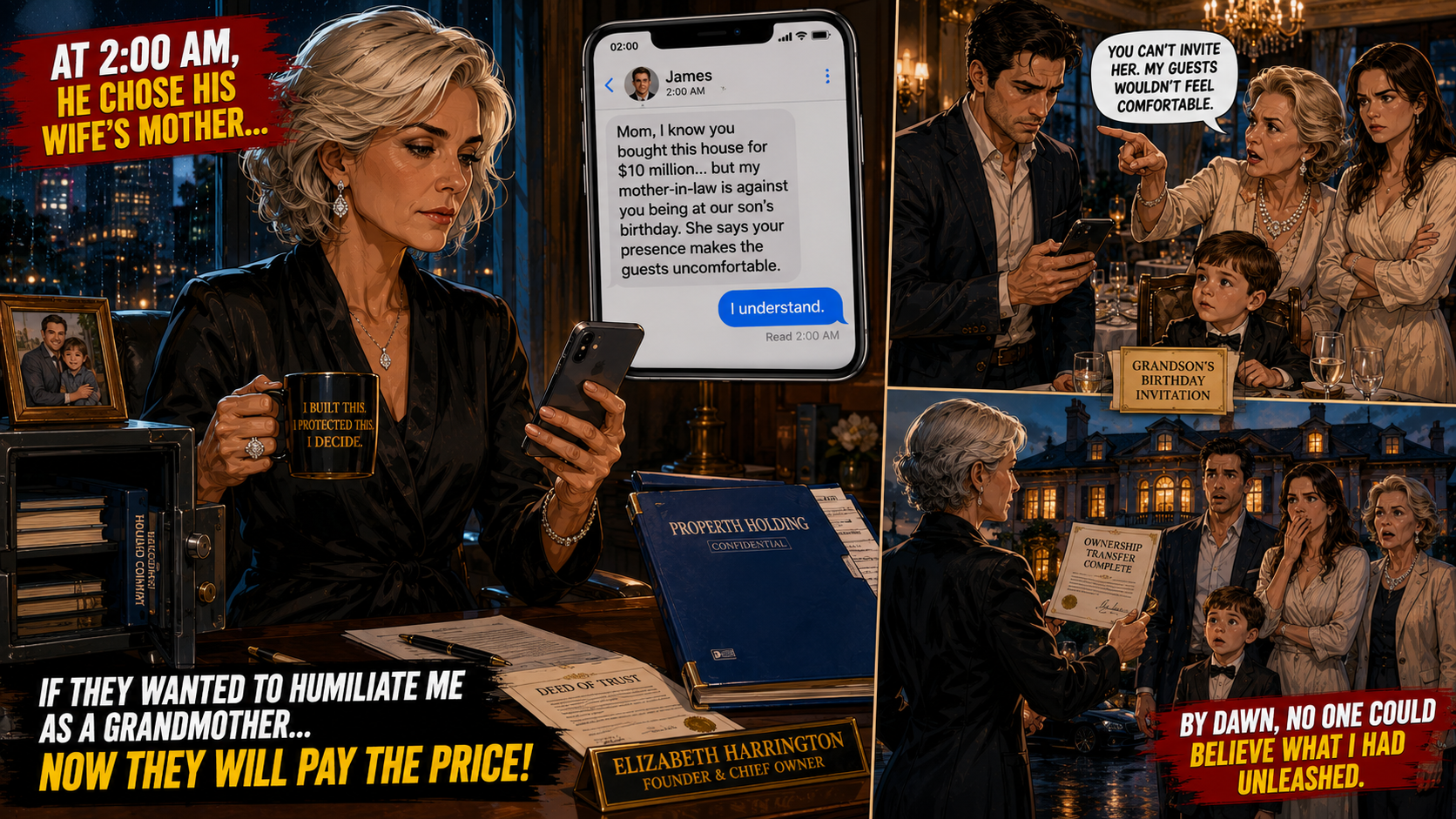
My phone buzzed while I was baking cookies, and when I checked it, I saw a text from my son, Danny: “Mom, I know you just bought us the house, but Sarah’s dad says you can’t come for Thanksgiving.” I stared at the words over and over, unable to believe them. Just the day before, I had signed papers giving Danny and Sarah a $350,000 house after six years of sacrifice and saving every extra penny from my retirement money. I had skipped vacations, driven my old car, and lived carefully so my son could finally have a real home. Standing in the grocery store surrounded by families preparing for Thanksgiving dinners together, I realized I had somehow become the outsider in the very family I had spent my life supporting. I typed many angry replies, but in the end, I only sent one word: “Okay.” That single word changed everything. Back in my car, I sat staring at the purple notebook containing all the house documents. The more I thought about it, the more painful the truth became. Over the years, I had paid for Danny’s expensive wedding, their honeymoon, furniture, emergency bills, and even his car. Altogether, I had given them nearly $185,000 before the house. Yet despite everything, they had allowed Sarah’s father, Richard, a man I barely knew, to decide that I wasn’t welcome at Thanksgiving. Sitting there in the parking lot, I realized this wasn’t just about one dinner. It was about years of being treated like a wallet instead of a mother. Something inside me shifted that afternoon. I wasn’t heartbroken anymore. I was finally seeing clearly. That night, I carefully reread the house agreement and discovered that Arizona law allowed large gifts to be revoked within a 30-day waiting period if the recipient behaved with gross ingratitude. Suddenly, the text message excluding me from Thanksgiving felt far more significant than hurt feelings. By morning, I had contacted my lawyer, Linda Martinez, and explained everything. She reviewed my records, the text message, the financial gifts, and the timing of the rejection, then told me I had a strong case to cancel the house transfer. I signed the cancellation papers with the same blue pen I had used to give Danny the house only days earlier. This time, however, I wasn’t acting out of generosity. I was protecting my dignity. When Danny received the cancellation notice, panic immediately followed. He called me repeatedly, furious and desperate, while Sarah accused me of manipulation and cruelty. But for the first time in years, I refused to bend. I calmly reminded them of every loan, every unpaid favor, and every sacrifice I had made while they treated my kindness like an obligation. Soon afterward, my lawyer formally demanded repayment of $28,000 in documented loans Danny still owed me. Their attempts to threaten lawsuits failed quickly because my paperwork was perfect. For years, Sarah had mocked me for saving every receipt and keeping detailed records. Now those same records became undeniable proof of how much I had given them.
As the pressure built, I began investigating Richard, the man who had caused so much division in my family. A private investigator uncovered that Richard’s furniture business had collapsed, leaving him deeply in debt and secretly living with Danny and Sarah rent-free for over a year. Even worse, messages revealed he had spent months encouraging Sarah to pressure me for money while convincing her I was controlling and manipulative. Richard viewed me not as family, but as a financial resource he needed to exploit. When I shared the evidence with extended family members, the truth spread quickly. Relatives who once admired Danny and Sarah began questioning how they could treat me so poorly after everything I had done for them. Meanwhile, Danny and Sarah’s financial situation collapsed. Banks rejected their loan applications, they sold Sarah’s Honda far below its value, emptied their savings, borrowed from friends, and even accepted money from Sarah’s disappointed mother just to repay part of the debt. The stress finally forced them to confront the real problem: Richard himself. During a massive argument, Sarah realized her father had manipulated her for years while contributing nothing except poison and entitlement. Danny finally stood up to him and demanded he leave their apartment immediately. Richard stormed out, angry and bitter, but his influence over their marriage had finally been broken. Eventually, Danny managed to repay $25,000, though he still owed the remaining balance. Rather than forgive the debt completely, I instructed my lawyer to create a formal repayment contract with interest, turning the arrangement into a legitimate legal loan. Danny signed it, fully understanding that our relationship had fundamentally changed. He was no longer a son automatically entitled to his mother’s endless support. He was someone who had to rebuild trust through responsibility and actions. Although the payments arrived every month on time, the emotional distance between us remained cold and careful. The lesson had finally reached him, but the damage still lingered.
Weeks later, Danny sent me an email unlike anything he had written before. There were no excuses, no manipulation, and no requests for help. Instead, he admitted he had treated me like a piggy bank instead of a mother and confessed he had allowed Sarah and Richard to influence him because it was easier than defending me. The honesty in his words felt genuine. After several weeks of silence and reflection, I finally agreed to meet him face to face. Sitting in my living room, Danny apologized through tears and admitted that losing the house, selling their belongings, and facing public embarrassment had forced him to recognize the person he had become. For the first time in years, I believed he finally understood the pain he had caused. I told Danny clearly that forgiveness did not mean returning to the way things were before. Trust would need to be rebuilt slowly through consistent behavior, not emotional promises. Later, Sarah also apologized sincerely, admitting she had allowed her father’s bitterness and manipulation to poison her thinking. She confessed she had mistaken my generosity for control and had treated my love as an obligation rather than a gift. I listened carefully, watching their expressions and body language, searching for signs of sincerity. Though I wasn’t ready to fully trust them again, I saw something different in both of them: humility, accountability, and the painful awareness of consequences.
Over time, we cautiously began rebuilding our relationship through small dinners, careful conversations, and strict boundaries. I bought myself a small cottage near Flagstaff, a peaceful place that represented my independence and self-worth. Danny and Sarah understood that invitations into my life now had to be earned, not expected. Richard remained permanently excluded from our family. In the end, taking back the house was never truly about revenge or money. It was about dignity. I finally learned that loving someone does not mean allowing yourself to be used, and sometimes the strongest act of love is refusing to continue enabling disrespect. By walking away, I forced my son to confront the truth, and in doing so, I reclaimed both my peace and my self-respect.