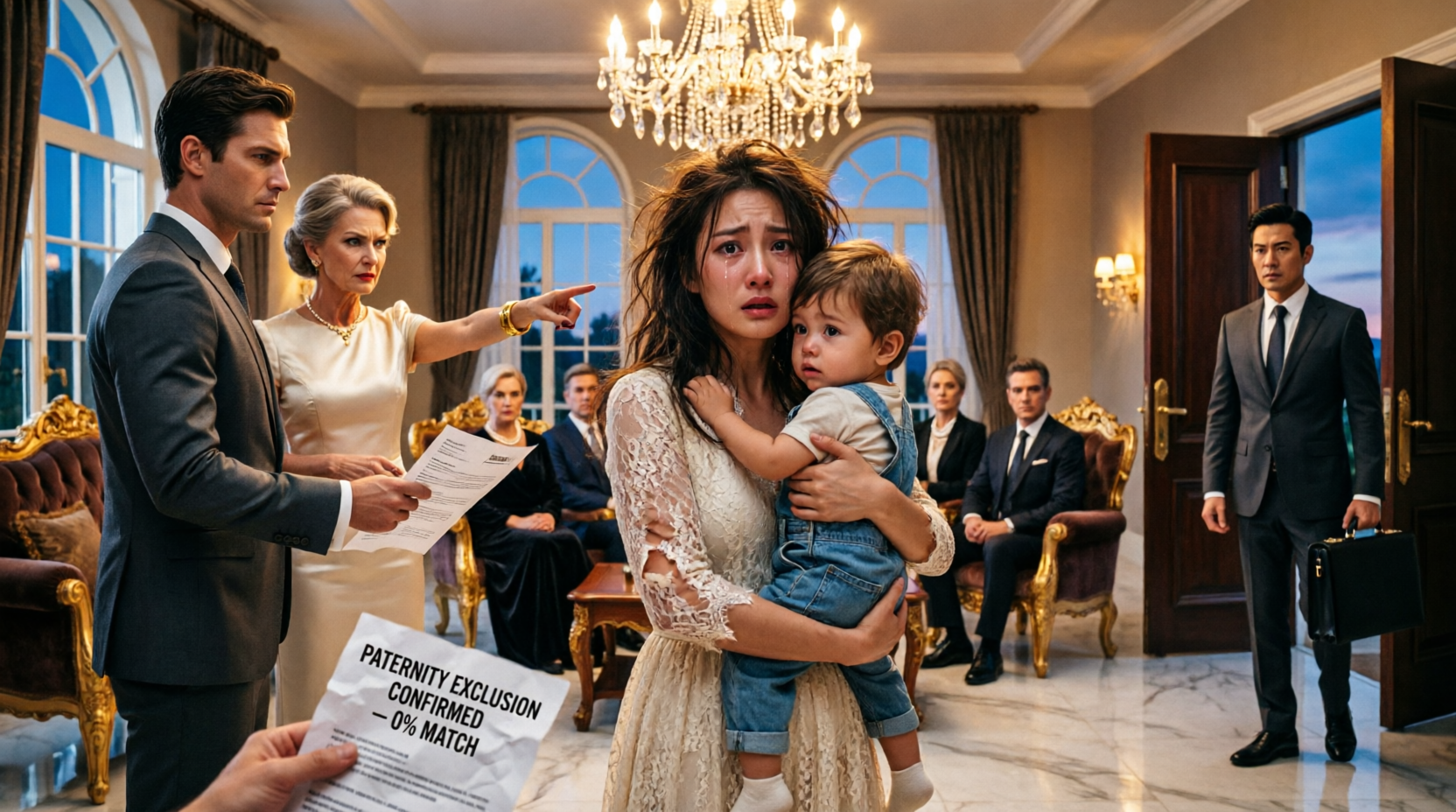
MY HUSBAND CALLED ME: “COME HOME EARLY TONIGHT. MY MOM IS HOSTING A FAMILY DINNER.” WHEN I WALKED IN, EVERY RELATIVE WAS ALREADY IN THE LIVING ROOM… BUT NO ONE WAS SMILING. MY HUSBAND HANDED ME A PIECE OF PAPER. “DNA TEST RESULTS. THE CHILD ISN’T MINE.” MY MOTHER-IN-LAW POINTED STRAIGHT AT MY FACE AND SAID: “GET OUT OF MY HOUSE.” AND AT THAT EXACT MOMENT… A STRANGER WALKED IN.
The DNA Test That Threw Me Out of the Family The DNA report was still shaking in my hand when my mother-in-law pointed toward the front door and said, “Get out of my house.” No one gasped. No one reached for the toddler in my arms. No one said, Diane, stop. That’s enough. The room simply went still, as if every person seated in that polished suburban living room had been waiting for her to say the sentence they were too polite to say themselves. I stood near the fireplace with my son Ethan pressed against my hip, one small hand gripping the collar of my dress. His cheek was warm against my shoulder. He smelled faintly of strawberries, baby shampoo, and the yogurt I had wiped from his face only hours earlier. Behind me, the late-evening light slanted through Diane’s tall windows, catching on framed family photos, crystal lamps, and the small American flag displayed in a silver stand on the mantel for every holiday, every birthday, every family gathering she wanted to look respectable. Across the top of the paper in my hand, the words read: DNA test results. Beneath that came lines of numbers, markers, percentages, and one sentence cold enough to freeze an entire marriage. Probability of paternity: 0%. My husband, Adam, had said it out loud a moment earlier. “The child isn’t mine.” Not our son. Not Ethan. The child. His voice had not cracked. That was what frightened me most. It was flat, rehearsed, almost tired, as if he had already spent weeks grieving a truth he never gave me the chance to explain. I searched his face for anger, for confusion, for one flicker of doubt that might make room for me. But all I found was distance. Then Diane stepped forward. She wore a cream blouse, pearls at her throat, and the expression of a woman who believed she had been waiting too long for justice. She pointed directly at me, her finger steady, her eyes colder than anything I had ever seen in that house. “Get out of my house.” That was the moment something broke. Not my love. Not completely. Something deeper. The belief that truth alone could protect me. Three hours earlier, I had been standing in my own kitchen rinsing strawberries for Ethan. He was in his high chair, swinging his little legs beneath the tray, humming in that off-key toddler way that made every ordinary afternoon feel softer than it had any right to. Yogurt was smeared across one cheek. His curls were damp from his nap. When I wiped his face with a warm cloth, he giggled like I had told the best joke in the world. My phone rang while I was reaching for a clean towel. Adam.
“Hey,” I said, tucking the phone between my shoulder and ear. “You’re calling early.” There was a pause. “Can you come over to my mom’s tonight?” I frowned. “Tonight?” “Yeah. She’s doing a family dinner. She wants everyone there by six.” I looked at the clock on the microwave. It was barely three. “That’s sudden.” “She just put it together.” His voice was wrong. Not cold. Not warm. Tight, like a shirt buttoned at the throat. “Is everything okay?” I asked. “Yeah,” he said too quickly. “Just come.” Then he hung up. I stood in the kitchen with the towel in my hand and listened to the sudden silence. Ethan reached for another strawberry. I told myself not to overthink it. Diane was always planning last-minute dinners. She loved gatherings, or more accurately, she loved gathering people where she could arrange them. Sunday lunches. Holiday brunches. Birthday cakes. Barbecues in the backyard beneath strings of white lights. She liked control wrapped in hospitality, and everyone had learned to call it tradition. Still, something about Adam’s voice stayed with me. By 5:45, I had Ethan dressed in his little blue shirt with the tiny buttons that made him look much older than he was. I put on a simple white floral dress, brushed my hair, and kept my makeup light. Normal. That was what I kept telling myself as I buckled Ethan into the car seat. Everything is normal. The drive through our New Jersey suburb was quiet. The sun was lowering behind the maples, turning the sidewalks gold. Kids rode bikes near the cul-de-sac. A man down the block watered his lawn in a Rutgers sweatshirt. American flags hung from porches in that easy, everyday way that made the whole neighborhood look safe from a distance. Diane’s house came into view at the end of a wide, tree-lined street. Large, white, immaculate, with black shutters, trimmed hedges, and a front porch that looked like it belonged in a real estate brochure. Adam had grown up in that house. His father had died when he was in college, and ever since, Diane had treated the place like both a shrine and a throne. As soon as I pulled into the driveway, my stomach tightened. Every car was there. Adam’s SUV. Karen’s white Lexus. Uncle Rob’s pickup. His cousin Mark’s old sedan, the one that only appeared when something important was happening. Even Diane’s neighbor’s car was parked along the curb, which meant extra chairs had probably been borrowed. “That’s a lot of people,” I whispered. Ethan clapped his hands, delighted by the change of scenery. I carried him up the walkway, adjusting him on my hip. Before I could knock, the door opened. Diane stood there. She did not smile. “Come in,” she said. No hug. No hello. No comment about Ethan’s shirt.
Just come in.
The air inside felt heavy. Too warm. Too still. I stepped into the living room and stopped.
Everyone was already seated.
Not at the dining table. In the living room.
Chairs had been arranged in a loose semicircle facing the center of the room, like a family meeting, or worse, like a hearing. Conversations cut off the second I appeared. Eyes turned toward me one by one. Karen sat with her arms crossed tightly. Uncle Rob leaned back in his chair, mouth set in a hard line. Adam’s cousins avoided my eyes, but not enough to hide that they had already formed opinions.
Adam stood near the window.
He did not come toward me.
He did not reach for Ethan.
He did not say, You made it.
He held an envelope in one hand.
“Hi,” I said, though the word came out thinner than I intended.
No one answered.
Diane closed the door behind me.
“Sit down,” she said.
I did not.
“What is this?” I asked.
Adam walked forward slowly and handed me the envelope without a word.
My fingers felt clumsy as I opened it. The paper inside was crisp, official-looking, with a lab name printed at the top.
North Valley Diagnostics.
DNA test results.
For a second, the words did not mean anything. They floated in front of me like something written in another language.
Then I saw the line.
Probability of paternity: 0%.
The room seemed to tilt.
I looked up at Adam.
He finally spoke.
“The child isn’t mine.”
And just like that, my marriage became a courtroom, and I was already guilty.
For a moment, I could not hear anything. The room was full of people, full of furniture, full of eyes, but it felt like I had been sealed inside glass. My heartbeat thudded in my ears, loud and uneven.
Ethan tucked his face into my neck.
He did not understand words like paternity or DNA. But children understand tension before they understand language. His fingers tightened around my dress.
“That isn’t true,” I said.
My voice sounded too quiet.
“It can’t be.”
No one responded.
That silence was worse than shouting.
Diane stepped forward first, as if she had been waiting for her cue.
“It’s right there in black and white,” she said. “Scientific. Verified.”
“Verified by whom?” I asked, gripping the page. “Where did this even come from?”
Adam’s jaw tightened.
“I ordered it.”
The words hit harder than Diane’s accusation.
“You ordered it?”
“A few weeks ago.”
“A few weeks ago,” I repeated slowly. “You did this behind my back?”
“I needed to know.”
“Know what?”
His eyes dropped for half a second, then returned to mine.
“Whether you had been unfaithful.”
A murmur moved through the room.
Karen shifted in her chair.
“Well,” she muttered, just loud enough for everyone to hear, “it’s not like these things come out of nowhere.”
I turned toward her.
“Excuse me?”
She shrugged, avoiding my eyes. “Tests don’t lie.”
“That’s not always true,” I said. “There can be mistakes. Mix-ups.”
Uncle Rob leaned forward with a heavy sigh.
“You expect everyone here to believe this is a lab error?”
“Yes,” I said, louder now, “because I know the truth.”
Diane’s eyes narrowed.
“And what is that?”
I held her gaze.
“I have never been unfaithful to your son.”
The words were plain. Direct. The truth as steady as I could make it.
But instead of relief, or even confusion, I saw doubt move across their faces. Not new doubt. Old doubt. The kind that had been fed before I arrived.
Diane shook her head slightly.
“I raised my son to be many things,” she said. “A fool is not one of them.”
My chest tightened.
“So that’s it? You all decided based on one piece of paper?”
“It’s not just paper,” Karen snapped. “It’s evidence.”
“Evidence of what?” I demanded. “A result none of you even understand?”
Adam looked at me then. Really looked.
For one split second, I thought I saw something flicker behind his eyes. Doubt. Fear. Maybe a memory of the life we had built before this room swallowed it.
Then it disappeared.
“Explain it,” he said.
His voice was not angry.
That would have been easier.
It was tired.
“Explain how a test says I’m not the father.”
I opened my mouth, then closed it.
Because how do you explain something you do not understand yourself?
“I don’t know,” I admitted. “But I know it’s wrong.”
“That’s not good enough,” Diane said sharply.
Ethan whimpered.
The sound broke something in me.
“He’s your grandson,” I said, my voice softer now, almost pleading despite myself. “Look at him.”
No one moved.
“Look at him,” I repeated.
Adam hesitated but did not step closer.
Diane did not even glance at the baby.
“He looks like every other child at that age,” she said. “That proves nothing.”
The room tilted again.
I tightened my hold on Ethan, grounding myself in the warmth of his small body.
“This is insane,” I whispered. “All of you. This is insane.”
“No,” Diane said. “What’s insane is thinking you could deceive this family.”
“I didn’t deceive anyone.”
“And yet here we are,” Karen muttered.
The whispers started then, low and ugly.
“She seemed so sweet.”
“I always thought something was off.”
“Poor Adam.”
“Raising another man’s child.”
Each word chipped away at me piece by piece.
I looked back at my husband.
He stood there silent, not defending me, not stopping them, not protecting the son he had tucked into bed every night for two years. He just let it happen.
That hurt more than the paper.
“You believe them?” I asked. “You really believe I would do this to you?”
He did not answer right away.
In that pause, I got my answer.
“I don’t know what to believe,” he finally said.
Something inside me went very still.
Not anger. Not panic.
Clarity.
Because in that moment, I understood that the verdict had been reached before I ever walked through the door. The dinner was never a dinner. It was a stage. The envelope was not a question. It was a sentence.
Diane stepped forward again.
“This has gone on long enough,” she said. “You have embarrassed this family enough for one night.”
I straightened slowly.
“I did not embarrass anyone,” I said. “You did that yourselves.”
Her eyes hardened.
“Leave.”
I looked at her.
“Get out of my house.”
The words landed final and sharp.
I looked around the room one last time. At the people I had spent years trying to belong to. At Karen, who had once asked me to help decorate for her son’s graduation party. At Uncle Rob, who had held Ethan at Christmas and said he had Adam’s smile. At Diane, who had framed family photos on every wall but apparently had no room in her heart for a child once a paper frightened her.
Then I looked at Adam.
The man I had trusted.
The man who had tested our child behind my back and invited me into a room full of witnesses for my humiliation.
“Okay,” I said softly.
I turned toward the door.
My hand had just reached the handle when it opened from the outside.
A man I had never seen before stepped in.
He wore a charcoal coat, carried a leather folder, and looked slightly out of breath, as if he had driven there faster than planned. His eyes moved across the room, taking in the semicircle of family, my face, the baby in my arms, and the paper still clenched in my hand.
“Excuse me,” he said calmly. “I believe we need to talk about that DNA test.”
Everything stopped.
Diane was the first to recover.
“And who exactly are you?” she demanded. “This is a private family matter.”
The man reached into his jacket and produced an identification card.
“My name is Daniel Reeves. I’m a case coordinator with North Valley Diagnostics.”
Adam’s expression shifted.
“That’s the lab,” he said under his breath.
Daniel nodded once.
“Yes, sir. The same lab that processed the report you’re holding.”
A ripple of tension moved through the room.
Diane crossed her arms.
“We already have the results. There’s nothing left to discuss.”
“I’m afraid that is not accurate,” Daniel said.
Something in his tone, careful, professional, certain, made my pulse quicken.
“What do you mean?” I asked.
He turned toward me, and his expression softened just enough to remind me that someone in the room still saw me as human.
“Ma’am, there has been a complication involving the sample processing for that test.”
The word complication hung in the air like a match above gasoline.
Adam frowned.
“What kind of complication?”
Daniel glanced around, clearly aware of the audience, but he did not lower his voice.
“A chain-of-custody discrepancy. Specifically, a labeling error during intake.”
Silence.
Not the heavy, judgmental silence from before. This was different.
Uncertain.
Diane scoffed.
“That sounds convenient.”
“It is not convenient,” Daniel replied. “It is documented.”
My grip tightened around Ethan.
Hope rose in me, fragile and terrifying.
“So what does that mean?” I asked.
Daniel looked directly at Adam.
“It means the sample attributed to you may not have been yours.”
The room shifted.
Karen sat straighter.
“That’s ridiculous. Labs have protocols.”
“They do,” Daniel said. “And when those protocols are breached, we are required to investigate and notify the involved parties.”
“Then why are we only hearing about this now?” Adam asked.
“The discrepancy was flagged during an internal audit that concluded earlier today,” Daniel said. “I came here as soon as I could.”
He opened his folder and removed another set of papers.
Diane shook her head.
“This does not change anything. The result we have is clear.”
“It is also unreliable,” Daniel said.
That landed.
You could feel the certainty in the room begin to crack.
Karen grasped for another argument.
“But even if there was a mix-up, that doesn’t automatically mean…”
“It means the original report cannot be considered valid,” Daniel interrupted, still calm. “Legally or medically.”
Adam ran a hand through his hair and stepped back as if he needed more space to process the collapse of his own accusation.
“So what happens now?”
Daniel held up the second document.
“We conducted an expedited retest using verified samples and corrected labeling procedures.”
My breath caught.
Everything in me went still again, but this time it was not emptiness.
It was anticipation.
“And?” I whispered.
Daniel looked at me, then at Adam.
“The probability of paternity is 99.99%.”
The words did not explode.
They settled.
Slowly, deeply, heavily, like a truth finally finding its place after being dropped from too high.
No one moved.
No one spoke.
I closed my eyes for one second.
Not in relief.
Relief would have meant this had not happened. Relief would have meant Adam had never doubted me, Diane had never pointed at the door, Ethan had never been reduced to a line on a paper. Relief would have been clean.
This was not clean.
When I opened my eyes, I looked at Adam.
He was not looking at the report.
He was looking at me.
Really looking, maybe for the first time since I stepped into that room.
“I…” he began.
The word went nowhere.
Diane stepped forward again, though her voice was no longer as steady.
“There has to be another explanation. You are saying the first test was wrong, and this one is right? Just like that?”
“I am saying,” Daniel replied, “that the second test followed verified protocol from start to finish. The chain of custody is intact, the samples were cross-checked, and the result is conclusive.”
Karen shifted uncomfortably.
“But the first one should never have been released in the condition it was,” Daniel continued. “The lab accepts responsibility for that procedural failure.”
His words were precise and professional, but they carried enough weight to tip the entire room.
For the first time since I had known her, Diane had no immediate answer.
I adjusted Ethan in my arms. He had relaxed again, his breathing soft, unaware that his identity had been questioned and restored in the span of minutes.
“This is my son,” I said quietly.
No one argued.
No one whispered.
And still, the silence did not feel like victory.
It felt like aftermath.
Because the truth had not merely walked into the room.
It had exposed everything already hiding there.
Daniel Reeves placed copies of the corrected report on the coffee table.
“If you have further questions, North Valley Diagnostics will cooperate fully,” he said.
Adam nodded distractedly.
“Thank you.”
Daniel gave a small, respectful nod to me, more than anyone else, then left.
The door clicked shut.
Suddenly, it was just us again.
The same room. The same people. The same family photos on the walls.
But everything had changed.
Karen’s arms were no longer crossed. Uncle Rob stared at the floor. Adam’s cousin looked toward the hallway like he wished he had chosen anywhere else to be that evening. Diane stood near the fireplace, her lips pressed together, her face pale beneath her makeup.
Adam picked up the new report and scanned it as though he needed to read it ten times before believing it.
“99.99,” he murmured.
I did not move closer.
The distance between us was no longer physical.
Karen glanced at him.
“You should say something.”
Adam looked up.
At me.
“I’m sorry.”
Two words.
Simple.
Small.
Far too late to land the way he wanted.
“Are you?” I asked.
He flinched.
Not dramatically. Just enough.
“Because you did not just question me,” I said. “You investigated me. You tested our son behind my back. Then you brought me here so your entire family could watch me be judged.”
“No one judged you,” Diane snapped automatically.
I turned to her.
“You told me to get out of your house.”
Her mouth closed.
“You pointed at me like I was something dirty you needed removed.”
Her eyes flickered, but she did not answer.
“That was not concern,” I said. “That was judgment.”
Adam stepped closer.
“I didn’t know it would become this.”
“You didn’t stop it either.”
That landed.
He exhaled slowly, dragging one hand over his face.
“I thought I needed answers.”
“And you decided I was not worth asking.”
There it was.
The center of it.
Not the test. Not even the accusation.
The choice.
He had chosen suspicion before conversation. Evidence before trust. His mother’s living room before our kitchen table.
Diane straightened, recovering just enough of herself to try one more defense.
“If there was confusion,” she said carefully, “it was because the situation raised reasonable concerns.”
I almost laughed.
“Reasonable?”
She held on to the word like it could still protect her.
“My son doubted me,” I said. “And instead of questioning that doubt, you supported it.”
“I protected my family.”
“And I am not your family?”
That stopped her.
For one second, something less certain moved across her face.
“You are,” she said stiffly. “But situations like this…”
“No,” I interrupted. “Situations like this show exactly who counts.”
The room went still again.
This time, the silence was mine.
Karen’s voice came softer now.
“No one expected the test to be wrong.”
“I understand that,” I said. “But every person in this room expected me to be wrong.”
No one could argue.
Ethan made a sleepy sound and rested his head against my shoulder. I kissed his hair and let that small, ordinary gesture bring me back to what mattered.
“I think you should stay,” Adam said suddenly. “We can talk. Figure this out.”
I looked at him.
Really looked.
At the man I had married, the father of my child, the person who had allowed a bad piece of paper to erase years of loyalty in a single evening.
“I will talk,” I said. “But not here.”
His brow furrowed.
“What do you mean?”
“I mean this is not something we fix in front of an audience. This is not a misunderstanding we laugh off over dinner.”
Diane inhaled sharply, but I did not look at her.
“This is about trust,” I continued. “And right now, that is not something I feel.”
Adam swallowed.
“So what are you saying?”
“I’m saying I’m going home with my son.”
“Our son,” he said softly.
I looked down at Ethan.
“Yes,” I said. “Our son. The son you forgot how to protect.”
Adam closed his eyes.
When he opened them, I saw pain there.
Good.
Not because I wanted him destroyed.
Because he needed to feel the truth of what he had done.
“I’ll come by tomorrow,” he said.
“You can ask first.”
He nodded.
That small nod told me he understood something had changed.
He was no longer the judge.
He was the one with something to prove.
I turned toward the door.
This time, no one stopped me. No one told me to leave. No one asked me to stay.
Somehow, that silence felt more honest than anything that had come before it.
Outside, the evening air was cooler, clearer. Diane’s house stood behind me, white and perfect, every window glowing as if nothing ugly had happened inside. A small American flag by the walkway moved gently in the breeze.
I buckled Ethan into his car seat.
He was half asleep, his little lashes resting on his cheeks.
As I drove away, I did not cry.
Not yet.
Some pain is too large to leave the body immediately. It waits until you are safe.
At home, I carried Ethan inside and locked the door behind us.
Only then did my hands begin to shake.
I sat on the nursery floor with him in my arms while the night settled around our small house. The room smelled of baby lotion, clean blankets, and the lavender detergent I used because it made everything feel softer than life actually was. Ethan slept against me without fear, trusting the rhythm of my breathing.
Trust.
The word stayed with me.
Not the kind people say in wedding vows. Not the kind printed on anniversary cards. The real kind. The quiet kind. The kind that exists in a toddler reaching for his father without doubt. The kind that lets a wife believe her husband will come to her before he turns her life into a family spectacle.
By morning, the house felt different.
Not broken.
Honest.
I made coffee, fed Ethan oatmeal, wiped banana from his fingers, and let the rhythm of ordinary tasks keep me standing. At nine, there was a knock at the door.
I did not rush.
I already knew who it was.
When I opened it, Adam stood alone on the porch.
No Diane. No Karen. No audience.
Just him.
He looked tired, not from lack of sleep, but from the heavier exhaustion of a man beginning to understand that being wrong is not the same as being forgiven.
“Can I come in?” he asked.
I hesitated, then stepped aside.
He entered slowly, as if uncertain he deserved to cross the threshold.
Ethan looked up from the living room rug.
“Dada!”
The sound hit both of us.
Adam froze for half a second, then crouched.
Ethan toddled toward him with both arms raised, completely unaware of DNA reports, family betrayal, or adult cowardice. Adam lifted him and held him so tightly I almost told him to loosen his grip.
“I don’t deserve how easy that was,” Adam said.
“No,” I replied. “You don’t.”
He nodded.
“I know saying I’m sorry isn’t enough.”
“It isn’t.”
“I know.”
There was no defensiveness in his voice now. No irritation. No attempt to rush me toward comfort.
“I am sorry for the test,” he said. “For doing it behind your back. For letting fear become suspicion. For letting my family’s voices get louder than yours.”
I stood near the counter, arms loosely folded.
“You didn’t trust me.”
“I doubted you,” he said. “And instead of coming to you, I went looking for proof to justify the doubt.”
“That is worse.”
“I know.”
He looked down at Ethan, who was now playing with the collar of his shirt.
“I stood there,” Adam continued, voice tightening, “and watched them treat you like you did not belong. I let my mother speak to you that way. I let Karen make comments. I let everyone stare at you.”
“Yes,” I said. “You did.”
His eyes lifted to mine.
“I don’t want to be that man.”
I studied him carefully.
Apologies are easiest after the truth has already cleared your name. What matters is what happens when no lab report is available, when the only thing standing between you and doubt is character.
“Your mother,” I said.
He exhaled.
“She was wrong.”
“That is not enough.”
“She knows she crossed a line.”
“Does she?”
He looked toward the window.
“She said this morning that she reacted badly.”
I gave him a look.
“Badly?”
He grimaced.
“I know.”
There it was. The old problem. Diane could wound like a knife and apologize like she had bumped into someone at the grocery store.
“I am not sitting in that living room again so everyone can pretend last night was just a difficult misunderstanding,” I said.
“I won’t ask you to.”
“And Ethan is not going over there until I decide it is safe for him emotionally.”
Adam looked pained, but he nodded.
“Okay.”
I watched him.
“You do not get to be surprised by that.”
“I’m not.”
“You brought him into that room too.”
His face tightened.
“I know.”
“No, Adam. I need you to really know. You didn’t just accuse me. You allowed our son to be questioned like he was evidence. Like his place in your family could be approved or revoked by committee.”
His eyes filled, but he did not look away.
“You’re right.”
Those two words mattered more than I expected.
Not enough.
But more.
“I’m not asking you to forgive me today,” he said. “I’m asking for the chance to rebuild what I broke.”
“There is no rebuilding if your mother still thinks she gets to decide who belongs in this family.”
“She doesn’t.”
“She did yesterday.”
“I know.”
“And you let her.”
He closed his eyes for a second.
“I did.”
Ethan babbled, patting Adam’s cheek with one sticky hand.
The tenderness of it made everything hurt more.
“I will give you a chance,” I said finally. “Not forgiveness. Not trust. A chance.”
Adam swallowed.
“That’s more than I deserve.”
“Yes,” I said. “It is.”
He accepted that.
That was where rebuilding began.
Not with a kiss. Not with a long embrace. Not with swelling music or promises made through tears. Real rebuilding begins with discomfort that no one runs from.
Three days later, Diane came to our house.
She arrived in a navy coat, pearls still at her throat, holding a small gift bag for Ethan as if wrapping paper could soften what she had done. Adam stood beside her, but he did not speak for her. That was new.
I opened the door and looked at her.
She looked older than she had in her own living room.
Not weak. Just less certain.
“May I come in?” she asked.
That was also new.
I stepped aside.
She entered and stood awkwardly near the sofa. Ethan was napping. The house was quiet except for the hum of the refrigerator and the distant sound of a lawn mower outside.
Diane looked around, taking in our home as if seeing it for the first time. The toys by the basket. The framed photo from Ethan’s first birthday. The grocery list on the fridge. The life she had almost helped fracture beyond repair.
“I was wrong,” she said.
No greeting. No small talk.
Just that.
I waited.
Her hands tightened around the gift bag.
“I judged before I understood. I treated you as though you had already been found guilty. I spoke cruelly. And I told you to leave my house when I should have been asking my son why he brought you there that way.”
Adam looked down.
I felt my throat tighten despite myself.
Diane continued, her voice stiff but steady.
“I am not good at admitting fault.”
“No,” I said. “You are not.”
Her mouth pressed into a line, but she nodded.
“I deserved that.”
“Yes.”
For once, she did not fight the word.
“I don’t expect you to forget it,” she said. “I don’t expect you to feel comfortable with me right now. But I am sorry.”
There was no perfect healing in that sentence. No magic. No undoing of the living room, the paper, the pointing finger.
But there was acknowledgment.
Sometimes that is the first clean brick in a ruined wall.
“Thank you for saying that,” I said.
Diane’s eyes flickered with relief, but I held up one hand slightly.
“I need you to understand something. Ethan is not a symbol of this family’s pride. He is a child. My child. Adam’s child. Your grandson. If you ever make his belonging feel conditional again, you will lose access to him.”
The room went very quiet.
Adam looked at his mother.
Diane looked at me.
A year earlier, I might have softened the sentence. I might have added please understand, or I don’t mean to sound harsh, or I know everyone was upset.
Not anymore.
Diane nodded.
“I understand.”
“I hope so.”
She placed the gift bag on the coffee table.
“I bought him a sweater,” she said softly. “But I can leave it here.”
“That’s fine.”
She did not ask to wake him.
That told me she had listened.
Weeks passed.
Trust did not return like a sunrise. It came back in fragments, and some mornings there was none of it at all. Adam and I spoke more than we had in years. Not easy conversations. Necessary ones. We sat at the kitchen table after Ethan went to sleep and talked about fear, his family, the way Diane’s certainty had shaped him, the way he had mistaken suspicion for action.
He admitted he had been afraid before the test.
Ethan had features neither of us could immediately place. A neighbor had made a careless joke about how he did not look like Adam. Karen had once said, “Those curls are interesting,” in that poisonous tone people use when they want a question to infect the air without owning it.
Adam let those comments grow.
Then instead of telling me, he ordered a test.
“That was the part that hurt most,” I told him one night. “Not that a thought crossed your mind. People get scared. People have irrational moments. But you chose secrecy. You chose your mother. You chose a report over a conversation.”
He nodded.
“I know.”
“And if Daniel Reeves had not walked in?”
Adam’s face went pale.
I let the question sit.
“If he hadn’t walked in,” I continued, “would you have let me leave with everyone believing that lie?”
He looked at the table.
“I don’t know.”
That answer hurt.
But it was honest.
I respected honest pain more than comforting lies.
“Then that is where we start,” I said. “With the fact that you don’t know.”
Marriage counseling came next.
Adam suggested it, which surprised me. We found a therapist in town, a woman with silver hair and direct eyes who did not let either of us hide inside polite phrases. The office sat beside a dental practice and a tax preparer, with an American flag outside the building and a waiting room full of old magazines. Ordinary place. Extraordinary work.
In the first session, Adam said, “I made a mistake.”
The therapist looked at him.
“A mistake is forgetting milk. What did you do?”
He swallowed.
“I betrayed my wife’s trust.”
I looked at him then.
Not with forgiveness.
With attention.
That became the slow rhythm of our life.
Attention.
Adam paid attention when Diane made a comment and corrected her before I had to. He paid attention when Karen tried to make light of that night at a family barbecue, saying, “Well, at least it all worked out,” and he answered, “No, Karen. It didn’t just work out. We hurt her, and we don’t get to make that cute.”
Karen flushed and said nothing.
I paid attention too.
To whether Adam told the truth when it was uncomfortable. To whether he asked instead of assumed. To whether he protected peace or merely avoided conflict. To whether I was staying because things had changed, or because I was afraid to leave.
That last question mattered.
A woman can remain in a marriage after betrayal and still be strong. She can leave and be strong. The strength is not in the direction. It is in whether the choice is truly hers.
For a while, I did not know my choice.
So I did not rush it.
Diane hosted Thanksgiving that year.
I almost refused to go.
Then Adam said, “We can stay home.”
No pressure. No guilt. No reminder of tradition.
Just we can stay home.
That was why I agreed to go for dessert only.
When we arrived, the house looked the same. White siding. Perfect hedges. Warm lights in every window. The flag on the porch moved in the cold November wind. My stomach tightened as I stepped inside with Ethan on my hip.
The living room had been rearranged.
Not in a semicircle.
Just chairs. Sofas. A coffee table with pie plates and mugs.
That small change told me Diane remembered.
Karen was there with her husband. Uncle Rob too. Conversation quieted when I entered, but not like before. This silence carried embarrassment, not accusation.
Diane came forward slowly.
“Happy Thanksgiving,” she said.
“Happy Thanksgiving.”
She looked at Ethan.
“He’s gotten so tall.”
“He has.”
She did not reach for him.
She waited.
After a moment, Ethan held out one hand toward the pumpkin cookie on the tray.
Diane smiled faintly.
“May I?”
I nodded.
That may I mattered.
Later, while Ethan played on the rug with toy trucks, Diane stood beside me near the dining room doorway.
“I think about that night often,” she said.
I looked at the room where I had once been judged.
“So do I.”
“I wish I had asked even one question before deciding I knew the answer.”
I did not rush to reassure her.
After a long moment, I said, “I wish that too.”
Her eyes shone, but she did not cry. Diane was not a woman who cried easily, and I respected that she did not try to use tears as currency.
“I am glad you came today,” she said.
“I came because Adam gave me the choice.”
She nodded.
“He is learning.”
“Yes,” I said. “He is.”
“And me?”
I looked at her.
“You are trying.”
It was not a full absolution.
It was the truth.
She accepted it.
That night, after we returned home, Adam carried a sleeping Ethan upstairs. I stood in the kitchen, washing two mugs by hand even though the dishwasher was empty. Snow had begun falling lightly outside, the first of the season, soft against the dark window.
Adam came back down and stood beside me.
“Thank you for coming today,” he said.
“I almost didn’t.”
“I know.”
“I may not next time.”
“I know that too.”
The old Adam might have argued. The old Adam might have tried to persuade me, to smooth things, to make my comfort secondary to his family’s expectations.
This Adam reached for a towel and dried the mug I handed him.
Progress can be that small.
A year after the DNA test, Ethan turned three.
We held the party in our backyard. Not at Diane’s house. Not under her perfect strings of lights. Our backyard, with uneven grass, folding chairs, a cooler full of juice boxes, and a grocery store cake Ethan chose because it had blue frosting and tiny candy stars.
Diane came early and asked where to put the napkins.
Karen brought fruit and apologized, awkwardly but directly, while helping me hang a banner between two maple trees.
“I said things that night I shouldn’t have,” she told me, keeping her eyes on the tape in her hand. “I believed the worst too fast.”
I looked at her.
“Yes. You did.”
She nodded.
“I’m sorry.”
“Thank you.”
That was all.
Not every apology needs a scene. Sometimes it just needs to be clean and not demand comfort from the person who was hurt.
Adam spent most of the party chasing Ethan around the yard while the children screamed with delight. Every time Ethan laughed, Adam looked as if the sound cost him something and gave him something at the same time.
Near sunset, as guests began leaving, Daniel Reeves arrived.
I had not seen him since that night.
He came with his wife and young daughter because, months earlier, Adam had written to the lab, not threatening, not demanding, but thanking Daniel for coming in person when he could have simply mailed a correction. A strange correspondence had followed. Then a polite invitation.
Daniel stood at the gate holding a small wrapped gift.
“I hope this isn’t intrusive,” he said.
“Not at all,” I replied.
Adam came over and shook his hand.
There was a quiet gravity between them.
“Thank you,” Adam said.
Daniel nodded.
“I was just doing my job.”
“No,” Adam said. “You did it with courage.”
Daniel looked at me.
“I’m glad things are better.”
I glanced at Adam, then at Ethan, who was attempting to feed cake to a plastic dinosaur.
“Better,” I said carefully. “And honest.”
Daniel smiled.
“That’s usually stronger.”
After everyone left, after the cake had been covered and the folding chairs stacked, Adam and I sat on the back steps while Ethan slept upstairs, exhausted and happy.
The yard smelled of cut grass and frosting. A small American flag from the party decorations leaned in a flowerpot near the steps.
Adam looked at it, then at me.
“I thought losing trust would be one big moment,” he said.
“It was.”
He nodded.
“Getting it back is a thousand small ones.”
“Yes.”
He reached for my hand, then stopped, waiting.
I looked at his hand.
Then I placed mine in it.
Not because everything was forgotten.
Because everything was remembered, and I was still choosing.
That was the difference.
I used to think trust meant never doubting.
Now I know better.
Trust means coming to the table before the test. It means asking the painful question before building a secret case. It means refusing to let family become a jury when love should have been a conversation. It means understanding that truth may clear a name, but it does not automatically repair the hands that threw the stone.
The DNA test was wrong.
But it revealed something accurate.
It showed me who Adam became under fear. It showed me who Diane became under pride. It showed me how quickly a family could turn a woman into an outsider when belonging had never been as secure as she thought.
And it showed them something too.
That I would not beg for a place I had already earned.
That my son’s worth was not up for discussion.
That an apology without change was just noise.
Sometimes people ask how a marriage survives a night like that.
The answer is, it does not.
Not the same marriage.
The old one ended in Diane’s living room when my husband stood silent and his mother pointed me toward the door.
What came after had to be built differently.
Slower. Stronger. With fewer assumptions and more truth.
Maybe that is why, when I think back to that night, I no longer see only the paper in my shaking hand or the cold faces in the room.
I see the door opening.
I see Daniel Reeves stepping inside with a folder full of corrected truth.
I see myself standing there with Ethan in my arms, no longer pleading for anyone to believe me.
Because the moment truth arrived, I understood something I should have known all along.
I was never the one who needed proving.
Video Player
The DNA test had cleared my name, but it had not cleared the room where they had tried to bury it.
For a while, I let everyone believe the worst part was over.
That was easier for them.
It was easier for Adam to say we were rebuilding. Easier for Diane to bring Ethan little sweaters and ask permission before holding him. Easier for Karen to apologize in small, careful ways while pretending she no longer remembered every word she had whispered in that living room. Easier for the whole family to fold the night into one softened phrase.
A terrible misunderstanding.
But I knew better.
A misunderstanding is when someone gets the time wrong for dinner.
A misunderstanding is when you think someone said six but they said seven.
A misunderstanding is not a husband ordering a secret DNA test, waiting weeks, arranging a full family audience, handing his wife a report in front of everyone, and standing silent while his mother points to the door.
That was not misunderstanding.
That was preparation.
And the longer I thought about it, the less that first report felt like an accident.
I did not say that at first. Not to Adam. Not to Diane. Not even to myself out loud. I had learned that when a woman survives a public accusation, everyone becomes impatient for her to become graceful. They want her to move on quickly because her pain is inconvenient after the truth comes out. They want the corrected report to function like a magic cloth, wiping the table clean.
But the table was not clean.
A stain remained.
It showed itself three weeks after Ethan’s birthday party, on a morning heavy with late-summer heat. I was loading the dishwasher while Ethan sat at the kitchen table pressing blueberries into his oatmeal one by one, deeply committed to the mess. Adam had left early for work. The house was quiet, ordinary, almost peaceful.
Then the phone rang.
The caller ID said North Valley Diagnostics.
My hand tightened around the mug I was holding.
“Mrs. Bennett?” a woman said when I answered.
“Yes.”
“This is Elaine Porter from North Valley Diagnostics. I’m calling regarding the case file connected to your son’s paternity test.”
My eyes moved to Ethan.
He looked up at me and smiled with purple oatmeal on his chin.
“What about it?” I asked.
“We have completed our internal review. There are a few details we are required to disclose.”
Required.
That word always means someone tried not to say something until a rule forced their mouth open.
I turned off the faucet.
“I’m listening.”
Elaine’s voice remained professional, but beneath it I heard caution.
“The original report was not only affected by a labeling discrepancy. During review, we found that the initial sample submitted as Adam Bennett’s was inconsistent with the identifying information provided on the submission form.”
I stood very still.
“What does that mean?”
“It means the DNA sample tested under your husband’s name did not appear to belong to your husband.”
The kitchen seemed to narrow around me.
“Are you saying someone else’s sample was used?”
A pause.
“We cannot speak to intent. But yes, the sample used in the first test was not consistent with the verified sample later collected directly from Mr. Bennett.”
I looked down at the counter. There was a blueberry stain near the sink, small and dark against the white surface.
“Who submitted the first sample?”
“The kit was registered online using Mr. Bennett’s information.”
“That isn’t what I asked.”
Another pause.
“The physical kit was mailed from a residential address.”
“Whose?”
“I’m not authorized to provide that verbally. The review packet is being sent to your home and to Mr. Bennett.”
I closed my eyes.
But I already knew.
By noon, Adam called.
His voice sounded like it had been dragged across gravel.
“You talked to the lab?”
“Yes.”
“I got the packet.”
I stood by the kitchen window, watching Ethan push a toy truck across the living room rug.
“And?”
Silence.
Then Adam said, “The first kit was mailed from my mother’s house.”
For a second, neither of us spoke.
Outside, two kids rode bicycles down the sidewalk, their laughter bright and careless in the August air. Across the street, a small American flag fluttered from our neighbor’s porch. The world looked painfully normal, the way it always does when something inside you is being rearranged.
“Adam,” I said slowly, “did your mother submit that test?”
“I don’t know.”
That answer was honest.
It was also not enough.
“Ask her.”
He exhaled.
“I’m going there now.”
“No,” I said.
He stopped. “What?”
“You are not going there first.”
“Sarah…”
“You come home first.”
He was silent.
I continued, “You are not going to walk into your mother’s house, let her tell you a version, and then bring that version back to me polished and softened. You come here. We read the packet together. Then we decide what questions need answers.”
A year earlier, Adam might have argued.
This time, he said, “Okay.”
He was home in twenty minutes.
He came through the front door carrying the packet like it weighed more than paper. His tie was loosened. His face was pale. Ethan ran toward him shouting “Daddy!” and Adam lifted him automatically, holding him tighter than usual.
For a moment, I let him.
Then I said, “The packet.”
We sat at the kitchen table after Ethan went down for his nap.
The report was clinical, careful, and devastating.
The first test kit had been ordered online under Adam’s name. The contact email matched one of his secondary accounts, but the shipping address was Diane’s house. The sample had been returned from the same address. The lab could not determine who physically collected the sample, but the sample profile did not match Adam’s verified profile from the second test.
Someone had submitted another man’s DNA under my husband’s name.
Not a lab mix-up.
Not random error.
A false sample.
Adam read the line three times.
I watched his face change.
First confusion.
Then denial.
Then something worse.
Recognition.
“You know something,” I said.
He looked up.
“No.”
“Adam.”
His jaw tightened.
“I don’t know. I just…”
He rubbed both hands over his face.
“When I first told my mom I had doubts, she said I should be careful. She said if I needed certainty, she could help me handle it discreetly.”
My stomach turned.
“You let her?”
“I thought she meant she’d help me order the test. I didn’t think…”
“You didn’t think,” I repeated.
Not loudly.
That made it worse.
He flinched.
“No,” he said. “I didn’t.”
I stood and walked to the sink because if I stayed at the table, I might say something that would break more than the truth already had.
Adam followed me with his eyes.
“I swear I didn’t know.”
I turned.
“But you gave her access.”
His face fell.
There it was again.
Not the crime, perhaps. Not the full intent. But the opening. The weakness. The space where his mother stepped in because he had made room for her.
“You were so ready to doubt me,” I said, “that you handed your suspicion to the person most eager to use it.”
He looked at the packet.
“I have to ask her.”
“Yes,” I said. “You do.”
But I already knew Diane would not make it easy.
She never did.
We went together that evening.
I did not want to go back into that house. Every part of me resisted it. But there are times when a woman must return to the room where she was humiliated, not to relive it, but to correct the angle from which everyone sees her.

