PART 5
The first time my brother did something that reminded me of Dad, he was standing in the rain outside a house none of us had ever visited.
He had a toolbox in one hand.
In the other, he held an envelope he was afraid to open.
But that happened later.
Before the rain, before the house, before I understood why Scott had started leaving Mom’s kitchen every Thursday at exactly seven fifteen, there was an ordinary Tuesday morning.
And there was Ed.
He called while I was folding laundry.
“Jenny? It’s Ed, from the shop.”
I smiled immediately.
By then, Ed no longer needed to explain who he was.
He had returned Dad’s watch, attended two family dinners, and developed an ongoing disagreement with Mom about whether she owed him an apple pie.
She said she did.
He said returning a stolen watch wasn’t a service you charged for.
She said he was getting the pie anyway.
“Everything all right?” I asked.
“Yes. Nothing wrong.”
Then he hesitated.
“I found something while cleaning out an old cabinet. It concerns your brother.”
I stopped folding.
Old habits are stubborn things.
For years, a sentence beginning with Scott’s name usually ended with someone needing money.
“What happened?”
“Nothing bad,” Ed said quickly. “I should have started with that.”
I sat on the edge of the bed.
“All right.”
“Would you come by the shop? I’d rather show you.”
An hour later, I parked beneath the faded blue sign above his front window.
SECOND CHANCES.
I had passed that sign dozens of times since he brought the watch home.
That morning, I noticed it properly.
Inside, the shop smelled of furniture polish, old books, and the coffee Ed reheated more often than he replaced.
A brass bell rang when I opened the door.
He stood behind the counter, wearing the same work shirt he had worn on Mom’s porch.
“Thank you for coming.”
“What did you find?”
He reached beneath the counter and set down a small ledger.
My stomach tightened.
Ed noticed.
“Sorry,” he said. “Poor choice of presentation, considering your family’s history with ledgers.”
Despite myself, I laughed.
He opened it to a page marked with a strip of yellow paper.
There was a date.
An amount.
Forty dollars.
And beneath it, another amount.
Eight dollars and sixty cents.
Beside both entries was my brother’s name.
SCOTT BRENNAN.
I looked up.
“He came back?”
Ed nodded.
“About six weeks after I returned the watch.”
I stared at the page.
“That was a long time ago.”
“It was.”
“He never told us.”
“He asked me not to mention it.”
“What was the extra money?”
“The new strap. I wouldn’t let him pay for the cleaning.”
I ran my finger along the edge of the book.
A few months earlier, forty dollars would have meant nothing to me except the price Scott had put on Dad’s memory.
Now it sat on a page beside his name, repaid.
“He said he owed you?”
“He said he owed everybody. But he could start with the person who had a receipt.”
I laughed once, then pressed my lips together.
Ed leaned against the counter.
“He came in three times before he managed to pay it all. First time, he brought twelve dollars. Second time, twenty. Last time, the rest.”
“Why are you showing me now?”
He turned the page slightly.
A folded note had been tucked beneath it.
“I was moving these old books to storage. Found this again. Thought you ought to have it.”
On the outside, in Scott’s handwriting, were four words.
FOR MOM, IF NEEDED.
I didn’t reach for it.
“What does that mean?”
“He asked me to keep it in case he didn’t follow through.”
“Follow through with what?”
“With changing.”
The shop seemed to grow quieter.
Ed looked toward the window.
“He told me people in your family had heard him say sorry so many times that the words had worn out. He wanted someone outside the family to know what he’d promised.”
“What did he promise?”
“That if he ever came back trying to sell something that wasn’t his, I should call your mother.”
I looked down at the envelope.
“He gave you permission?”
“Wrote her number on the back.”
My eyes stung.
For years, Scott had depended on people keeping his secrets.
Now he had asked a stranger to help stop him from making another one.
“May I read it?”
Ed shook his head gently.
“It’s addressed to your mother.”
I nodded, embarrassed.
“Of course.”
“I called him this morning,” he added. “Asked what he wanted me to do with it now. He said to send it home.”
I picked up the envelope.
It weighed almost nothing.
Still, I carried it to my car with both hands.
Mom was peeling apples when I arrived.
There were six on the kitchen table and a long curl of red skin hanging from the knife.
“Ed?” she asked when she saw the envelope.
“Scott.”
Her hand stopped.
I told her about the payments.
The twelve dollars.
The twenty.
The final sixteen dollars and sixty cents.
She set down the knife.
“He paid for the strap?”
“Yes.”
She looked toward Dad’s watch, resting in its open box on the sideboard.
Then she washed her hands, dried them carefully, and sat down.
The envelope had been sealed for more than two years.
She opened it with the blunt edge of the same butter knife Dad used to use on his mail.
There was one page inside.
Mom read it silently.
I watched her face.
When she finished, she folded it once and placed it on the table.
“Would you like me to leave you alone?”
“No.”
She pushed the letter toward me.
“You can read it.”
Mom,
I don’t know whether Ed will ever need to give you this.
I hope he doesn’t.
I keep trying to write an explanation for what I did with Dad’s watch, but every explanation sounds like I’m asking you to feel sorry for me.
I knew it was yours.
I took it anyway.
You trusted me in your house while you were grieving, and I used that trust to get something I wanted.
I can’t fix that by being sad about it.
I’m paying Ed back. He says I don’t have to, but I do.
I’m also writing down everything I owe people. I don’t know how long it will take.
There is something else I need to say.
When Dad was alive, I sometimes thought he helped me because he didn’t believe I could manage on my own. I was angry with him for making me feel small.
Now I think he was afraid of what would happen if he stopped.
I made him afraid.
I made you afraid too.
I don’t want the rest of your life to be spent wondering what I’ll do next.
If I come into this shop with anything that belongs to you, Ed has your number.
You don’t have to cover for me anymore.
Love,
Scott
I read the last line twice.
Then I looked at Mom.
She was staring at the apple peels.
“He was always so angry when your father asked where the money went,” she said.
“I remember.”
“Your father would wait until after dinner. He didn’t want to embarrass him in front of anybody.”
She rubbed a small spot on the table.
“Sometimes I was angry with Harold for giving him more. Sometimes I was angry with myself for being relieved when he did.”
I folded the letter along its original crease.
“Why didn’t Scott tell you he paid Ed?”
Mom looked up.
“Perhaps he finally did something without needing us to applaud.”
That quieted me.
I had arrived carrying evidence that my brother had changed.
Mom seemed more interested in the fact that he had kept going when nobody was watching.
She put the letter in the kitchen drawer beside her address book.
Then she picked up another apple.
“Are you staying for lunch?”
I began noticing Thursdays after that.
Scott came to Mom’s house after work, ate with her, fixed whatever needed fixing, and left at seven fifteen.
Always seven fifteen.
If she offered coffee, he took it in a travel mug.
If she asked him to stay for dessert, he wrapped a piece to go.
The first time I asked where he was headed, he said, “I’ve got something to do.”
It was an answer he had used before.
I hated that I remembered.
One Thursday, Mom asked him to look at the loose hinge on the back gate.
“I can do it Saturday,” he said.
“It’ll only take a minute.”
“I know. I’m sorry. I have to leave.”
He glanced at the clock.
Seven twelve.
After he left, I stood at the window watching his taillights disappear.
“What?” Mom asked.
“Nothing.”
“Jenny.”
I turned.
“Does it bother you that he won’t say where he’s going?”
She wrapped the remaining pie.
“A little.”
“Then why don’t you ask?”
“I have.”
“What did he say?”
“That it’s something he wants to explain when he’s ready.”
I crossed my arms.
“And you’re comfortable with that?”
“No,” she said. “But I’m trying to learn the difference between being worried and being entitled to every detail of his life.”
I didn’t answer.
She tied the bag closed.
“Trust has to leave him somewhere to stand, Jenny.”
Two weeks later, Scott called me at six thirty on a Thursday.
His voice sounded strained.
“Can you give me a ride?”
“Where’s your truck?”
“Outside work. Won’t start.”
“I can take you to Mom’s.”
“I already called her. Told her I can’t make dinner.”
“So where are you going?”
A pause.
Then he gave me an address on the far side of town.
“Please don’t make a thing of it.”
“I haven’t made a thing of anything.”
“Jen.”
I picked up my keys.
“I’m coming.”
He was waiting beside his truck with a toolbox at his feet.
When he climbed into my car, he smelled of sawdust and cold air.
“Thank you.”
“Did you call a mechanic?”
“Tomorrow.”
“You need the truck for work.”
“I know.”
The old irritation rose in me before I could stop it.
A broken truck.
An unexplained destination.
A toolbox.
I was already arranging the pieces into a familiar shape.
Then Scott said, “It’s the starter. I’ve got enough put aside.”
I glanced at him.
He kept looking through the windshield.
“You were about to ask.”
I tightened my hands on the wheel.
“Yes.”
For a while, neither of us spoke.
Rain began tapping the glass.
When we reached the address, I found a narrow house with peeling white paint and a wooden ramp leading to the porch.
A porch light glowed above a crooked screen door.
Scott reached for the toolbox.
“I’ll get a ride home.”
“From who?”
“Someone.”
I turned off the engine.
He sighed.
“You don’t have to come in.”
“I know.”
He looked at me then.
For a moment, I thought we were going to argue.
Instead, he said, “All right. But let me explain before you start asking questions.”
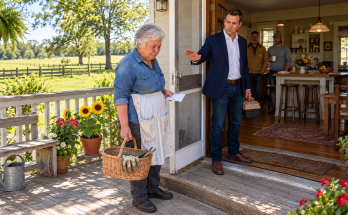
An elderly woman opened the door before we reached it.
“There you are,” she said. “I thought you’d forgotten.”
“Truck trouble, Mrs. Ellis.”
“Oh, that old thing.”
“It heard you.”
She laughed.
Then she saw me.
Her smile faltered slightly.
“This is my sister, Jenny.”
The woman rested one hand on the doorframe.
“Your sister.”
“Yes.”
Rain dripped from the porch roof.
Scott shifted the toolbox.
“Can we come in?”
“Of course.”
The house was warm and smelled of tomato soup.
A television murmured in another room.
Near the window stood a small table with two bowls, two spoons, and a plate of buttered bread.
On the mantel was a framed photograph of a young man in a football uniform.
Beside it was another photograph.
The same man, older, standing outside a tavern.
Scott set down his toolbox.
“Where’s the leak?”
“Under the sink. I put a saucepan there.”
He took off his jacket.
“Jenny, this is Mrs. Ellis.”
She looked from him to me.
“Has he told you?”
“No,” I said.
Scott closed his eyes briefly.
Then he opened them.
“Her son owned the tavern.”
I looked at the photograph again.
The tavern where Scott had spent the forty dollars.
Mrs. Ellis sat down slowly.
“You’d better tell her properly.”
Scott pulled out a chair for me.
For once, I did what my younger brother asked without arguing.
He remained standing.
“After I paid Ed, I started making a list. People I owed. Things I’d taken. Promises I’d broken.”
I waited.
“I went back to the tavern because there was still a tab.”
“How much?”
“Two hundred and nineteen dollars.”
I stared at him.
“That was separate from—”
“Yes.”
Mrs. Ellis folded her hands.
“My son used to let regular customers settle up on payday.”
“I wasn’t very good at the settling-up part,” Scott said.
He tried to smile.
Nobody helped him.
“When I went back, the place was closed.”
I remembered hearing that.
A dark building on a street I rarely drove down.
“Her son had died,” Scott continued. “I found her name on a notice in the window.”
Mrs. Ellis looked at the photograph.
“Heart attack. Fifty-four.”
“I’m sorry,” I said.
“Thank you.”
Scott pulled out the other chair and sat.
“I came here to pay what I owed.”
“He brought cash,” she said. “In an envelope. Wrote the amount on the front like I was a bank.”
“I didn’t know what else to do.”
“I told him the business was finished.”
“And I told her that didn’t mean I hadn’t drunk the beer.”
Mrs. Ellis smiled faintly.
“He was very stubborn.”
I could imagine it.
Scott on this porch, holding money he had once spent years finding reasons not to repay.
“What happened?”
“She took it,” he said.
“And then he noticed the handrail.”
She nodded toward the window.
“It was coming away from the wall. I’d been meaning to find someone.”
Scott looked down at his hands.
“I tightened it before I left.”
“And the next week, he came back with the proper bolts.”
“The wood was splitting.”
“The week after that, he fixed the bathroom door.”
“It wouldn’t close.”
Mrs. Ellis lifted one shoulder.
“After a while, I started making soup on Thursdays.”
I looked at the two bowls.
For months, I had been wondering what my brother was hiding.
He had been eating soup with a woman whose son could no longer come home.
Scott spent the next half hour beneath the kitchen sink.
Mrs. Ellis put a third bowl on the table.
I offered to help.
She pointed me toward a drawer.
“Napkins.”
As I set them out, I noticed an envelope beside her chair.
SCOTT was written across it.
He saw me looking.
“She keeps trying to pay me.”
“And he keeps refusing,” Mrs. Ellis said.
“I’m not a plumber.”
“The sink doesn’t know that.”
He gave a muffled laugh from inside the cupboard.
I sat across from her.
“How long has he been coming?”
“Nearly eighteen months.”
I turned toward the sink.
“Eighteen?”
“Some weeks I only need a light bulb changed,” she said. “Some weeks I don’t need anything.”
Scott’s hands stopped moving.
Mrs. Ellis continued as if she hadn’t noticed.
“He still comes.”
For the first time that evening, I understood why he had wanted to keep this private.
At home, every good thing Scott did carried the weight of what had come before.
Every paid bill was a sign.
Every kept promise was progress.
Every mistake threatened to become proof that we had been foolish.
Here, he could arrive with a toolbox.
He could fix a sink.
He could be expected for supper.
I wondered whether I had given him any place in my own life where he could simply be my brother.
After we ate, Mrs. Ellis insisted on washing the bowls.
Scott checked the porch light.
I stood beside him under the awning, watching the rain.
“Why didn’t you tell us?”
He tightened a screw.
“I meant to.”
“When?”
“I don’t know.”
“Mom would have understood.”
“I know.”
He tested the light.
It flickered, then steadied.
“Then what were you afraid of?”
He lowered the screwdriver.
“That everybody would turn it into a story about Dad’s watch.”
I looked at him.
“It started with the watch.”
“Yes. But she didn’t.”
Through the window, Mrs. Ellis was drying the bowls.
Scott tucked the screwdriver into his back pocket.
“She had a whole life before I knocked on her door. So did her son.”
“I wasn’t going to—”
“I know. I’m telling you what I was afraid of.”
I stopped.
It was a distinction I hadn’t always allowed him.
He picked up the toolbox.
“I wanted to keep doing it long enough that it was something I did. Not another thing I said I was going to do.”
The rain pattered against the porch steps.
I thought of the letter in Mom’s drawer.
“You paid Ed.”
He glanced at me.
“He told you?”
“He found your note. Said you told him to send it home.”
Scott rubbed his forehead.
“I forgot I’d written half of that.”
“Mom read it.”
He swallowed.
“What did she say?”
“She went back to making pie.”
He looked worried.
Then I touched his arm.
“Scott. She kept it.”
His face changed.
Only a little.
But enough.
Before we left, Mrs. Ellis pressed the envelope into his hand.
He began to refuse.
“Open it at home,” she said.
“I told you—”
“It isn’t money.”
He looked at her.
“Then what is it?”
“Something I want you to have.”
He slipped it into his jacket.
In the car, he held it on his lap all the way back to his apartment.
Neither of us turned on the radio.
When I pulled up outside, he didn’t immediately get out.
“Do you want me to wait?” I asked.
He nodded.
He opened the envelope carefully.
Inside was a photograph.
His face went still.
“What?”
He handed it to me.
The picture showed Mrs. Ellis’s son behind the bar.
He was laughing at someone outside the frame.
At the edge of the photograph, half cut off, stood Scott.
Younger.
Thinner.
Holding a glass.
There was something written on the back.
He read it aloud.
“Michael wrote this after the Christmas fundraiser. I found it while sorting his things. I thought you should know he remembered this too.”
Below that, in another hand:
Scott Brennan stayed until two helping us clean up. Wouldn’t take a penny. Good company when he lets himself be.
My brother stared at the dashboard.
Then he bent forward and covered his face.
I sat beside him.
I had seen Scott cry from shame.
From fear.
From the consequences of something he had done.
This was different.
A man who was gone had remembered him kindly.
And there was no way to ask whether he still would.
The following Thursday, Scott brought Mrs. Ellis to Mom’s house.
He called ahead this time.
“Can I bring someone?”
Mom looked at me while she held the phone.
Then she smiled.
“Of course.”
She made too much food.
Scott arrived carrying a covered dish.
Mrs. Ellis came slowly up the path, one hand on his arm.
Mom opened the door before they reached it.
For a moment, the two women stood looking at each other.
Then Mom said, “I understand you’ve been feeding my son.”
“Only Thursdays.”
“Well, come in. I’ll take a turn.”
At dinner, nobody asked Scott to explain himself.
Mrs. Ellis told us about Michael as a boy.
How he once brought home a duck in a cardboard box.
How he had practiced signing his name on the back of every grocery receipt because he was certain he would be famous.
How he opened the tavern after spending seventeen years managing someone else’s.
Scott listened with his fork resting on his plate.
Later, Mom told her about Dad.
The crooked shelves he refused to admit were crooked.
The camping trip when he forgot the tent poles.
The way he used to say he was only resting his eyes while falling asleep in front of the television.
Mrs. Ellis laughed so hard she had to put down her cup.
For a while, the room sounded as though it had before the funeral.
Then she noticed the velvet box.
“Is that the watch?”
Scott went still.
Mom nodded.
“Would you like to see it?”
She carried it to the table.
Mrs. Ellis held it gently.
She turned the worn steel casing toward the light.
“This is it,” she said.
“Yes.”
She looked at Scott.
“All that trouble from such a little thing.”
He lowered his eyes.
Mom reached across the table and touched his hand.
“And some good.”
After dinner, Scott drove Mrs. Ellis home.
I stayed to help Mom wash up.
She handed me a plate.
“I owe you an apology.”
I looked at her.
“For what?”
“I thought you were being too suspicious about Thursdays.”
“You were right.”
“No,” she said. “You were worried for a reason.”
I dried the plate slowly.
“I almost followed him once.”
“I know.”
I stared at her.
“You had your keys in your hand the whole time you were telling me you weren’t worried.”
I laughed, embarrassed.
She smiled.
Then she looked toward the driveway.
“He’ll make mistakes again.”
“I know.”
“So will we.”
I put the plate away.
Mom drained the sink.
“We can’t spend the rest of our lives making him audition for a place in this family.”
I leaned against the counter.
There it was.
The thing I had been doing without naming it.
Every visit, another test.
Every question, another chance for him to fail.
“I don’t know how to stop worrying,” I admitted.
“Neither do I.”
She dried her hands.
“But perhaps we can stop calling all of it love.”
Winter arrived early that year.
Scott repaired his truck.
Mrs. Ellis began coming for Sunday lunch once a month.
Ed finally accepted the apple pie, then returned the dish with a note complaining that Mom had sent enough for six people.
She sent another the following week.
Life settled into a shape I hadn’t expected.
Not the old shape.
There were still empty chairs.
Still moments when Mom reached for the telephone to tell Dad something before remembering.
Still questions about Daniel that no recovered document had answered.
But there were other things now.
An extra place at the table.
A reliable knock on Thursday evenings.
My brother’s name on envelopes containing money he owed, with smaller balances written beneath it each time.
Then, one snowy afternoon, Scott asked Mom if he could take Dad’s old workbench.
It stood in the garage beneath a sheet.
Dad had built it himself.
For years, Scott had borrowed his tools and returned them late, if at all.
Mom looked toward the garage door.
“What for?”
“I’ve rented a little space behind the repair shop where I work. I’m going to do furniture repairs on Saturdays.”
“More work?”
“Different work.”
He smiled nervously.
“Something I like.”
She asked about the rent.
The tools.
The time.
He answered each question.
He had written the figures down.
When he finished, Mom sat quietly for a while.
Then she said, “Your father always wanted you to find something you cared enough about to be patient.”
Scott looked at his notes.
“Can I take it?”
“Yes.”
He nodded once.
Then he went outside before either of us could say anything else.
Through the window, we watched him lift the sheet from the workbench.
He brushed dust from its scarred surface.
Then he stood there with one hand resting on the wood.
Mom turned away first.
The workshop opened in February.
There was no ribbon.
No announcement in the newspaper.
Scott hung a hand-painted sign beside the door.
BRENNAN REPAIRS.
Underneath, in smaller letters:
Furniture. Household repairs. Honest estimates.
Ed brought him a broken chair as his first job.
Mrs. Ellis brought sandwiches.
Mom brought a broom, because she said a man could have all the talent in the world and still need someone to point out the dirt in the corners.
I brought a plant.
Scott stared at it.
“What am I supposed to do with that?”
“Keep it alive.”
“That sounds like a test.”
I opened my mouth.
Then I laughed.
“You’re right.”
I took the plant back.
He caught my wrist gently.
“Leave it.”
“You don’t have to—”
“I know.”
He put it on the windowsill.
For the first time in a long while, the words between us were easy.
Mom visited the workshop alone a week later.
I only learned about it because Scott called me that night.
His voice was unsteady.
“Did you know?”
“Know what?”
“She brought the watch.”
I sat down.
“What do you mean?”
“She asked me to make a box for it.”
I pictured the velvet case on Mom’s dresser.
“She already has a box.”
“She wants one made from Dad’s wood.”
In the garage, beneath the workbench, Dad had kept a short length of walnut wrapped in newspaper.
He had saved it for years.
Whenever Mom asked what he planned to do with it, he said he was waiting for the right project.
Scott went quiet.
“Jen?”
“I’m here.”
“She gave it to me.”
I closed my eyes.
The watch.
The walnut.
Something precious placed in the hands of the person who had once taken it.
“What did you say?”
“I asked if she was sure.”
“And?”
“She said she’d bring it back home when the box was finished.”
I smiled.
“Sounds like Mom.”
He gave a shaky laugh.
Then he said, very softly, “She left it here.”
It took him three Saturdays.
He measured everything twice.
He called a friend about the hinges.
He ruined one piece of lining and started again.
When it was finished, the box was small enough to hold in one hand.
Dark walnut.
A brass hinge.
A soft cream lining.
Inside the lid, he had fitted a photograph of Mom and Dad taken on their fortieth anniversary.
Dad’s wrist was visible.
So was the watch.
Scott brought it to Sunday dinner.
He placed it in front of Mom and stepped back.
She opened the lid.
For a moment, she didn’t move.
Then she lifted the watch from its new resting place and looked at the workmanship beneath it.
“You made this?”
He nodded.
She ran her thumb along the smooth edge.
“Your father would have loved it.”
Scott pressed his lips together.
Mom looked up.
“I love it.”
He sat down quickly.
I passed him the potatoes before anybody could make him speak.
Later, after the dishes were cleared, I found him standing by the sideboard.
The new box rested where the velvet one used to be.
“You’re checking again,” I said.
He looked over his shoulder.
Then he smiled a little.
“Yes.”
“Still afraid it’ll disappear?”
He shook his head.
“I was looking at the hinge.”
“Of course you were.”
“It closes a little tight.”
“Scott.”
“What?”
“It’s a beautiful box.”
He looked at it again.
“Thank you.”
I stood beside him.
For years, I had wanted one moment that would settle everything.
One apology strong enough.
One act generous enough.
One promise I could believe without remembering all the others.
Instead, there had been twelve dollars on a shop counter.
A loose handrail.
Soup on Thursdays.
A repaired truck.
A piece of walnut Dad had never found a use for.
Scott closed the lid gently.
This time, I didn’t ask him where he was going next.
I asked if he wanted coffee.
He glanced toward the kitchen, where Mom and Mrs. Ellis were disagreeing about how much pie to send home with Ed.
“Yeah,” he said. “I can stay.”
And he did.
CLICK HERE TO CONTINUE READING PART 6: My Brother Sold Dad’s Watch for $40—But Its Secret Changed Our Family Forever
Story by Dramaverdict