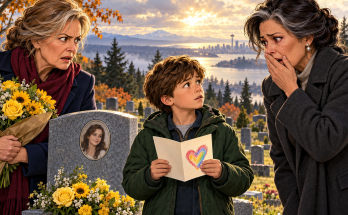
“No, sweetheart. Look at me.”
He did.
His eyes were full.
“I need you to hear this carefully. You were always enough.”
“Then why?”
There was no answer simple enough for a ten-year-old.
There was barely an answer I could hold comfortably myself.
“Because adults can be frightened and make terrible choices,” I said. “Because someone can care about a child and still fail to do what that child needs.”
“Doesn’t that mean they don’t care enough?”
I breathed in.
“It means caring isn’t the only thing that matters.”
He considered that.
I could see him trying to make the pieces fit.
For years, the story had contained a blank space.
Now the blank space had become a person.
And people were harder.
We spoke again with Dr. Adler.
I sat beside Miles while she helped us move through the facts slowly.
Adrian was his biological father.
He had not known Miles survived until Miles was almost one.
He had been seriously unwell.
There had been lies and control.
And later, when he had become stable and independent, he had still stayed away.
We did not hide that last part inside the others.
Miles listened without interrupting.
Then he asked, “Did Mom want him to come?”
“Yes,” I said.
“Did she love him?”
“Yes.”
“How do you know?”
I took a copy of Lena’s letter from my bag.
“There are things she wrote that I can show you when you’re ready.”
He looked at it.
“Not yet.”
“All right.”
Dr. Adler asked whether he had questions about meeting Adrian.
Miles stiffened.
“Do I have to?”
“No,” I said.
He looked at her for confirmation.
“You don’t have to decide today,” she told him.
His shoulders lowered slightly.
“What if I say yes and then change my mind?”
“Then you tell us.”
“What if he gets mad?”
I answered before I could stop myself.
“Then that tells us something important.”
Dr. Adler glanced at me, then back at Miles.
“Your job is to tell us how you feel. The adults will handle their own reactions.”
He sat quietly for a while.
Then he said, “Could I write to him?”
That was how it began.
Not with a hug.
Not with a photograph.
With a sheet of paper and a child trying to decide whether a stranger could be trusted with his questions.
Miles’s first letter took three evenings.
He started with Dear Adrian.
Crossed it out.
Tried Hello.
Crossed that out too.
Finally, he wrote only the name.
Adrian,
Do you know how to play baseball?
What is your favorite food?
Did you know Mom liked thunderstorms?
Then, at the bottom:
Why didn’t you send even one letter?
He folded the page so quickly that I knew he didn’t want me to comment.
“Can you make sure he gets it?”
“Yes.”
“Don’t tell him what to say.”
“I won’t.”
Adrian’s answer came through the arrangement we had agreed on.
I waited until Miles was home before giving it to him.
He carried it upstairs.
Twenty minutes later, he returned.
“He says he’s bad at baseball.”
I tried to read his expression.
“Is he?”
“He says he once got hit by the ball while standing in the wrong place.”
“That sounds possible.”
Miles almost smiled.
“He hates black olives.”
“So do you.”
“I know.”
He stood in the doorway for a moment.
Then he held out the letter.
“Can you read the last part?”
I took it.
You asked why I didn’t send a letter.
I wrote some, but I was afraid to send them.
That was wrong.
You did not cause that fear, and it was never your responsibility to make it easier for me.
You deserved an answer much sooner.
I cannot give you back the years I missed.
I can answer your questions honestly now.
I read it twice.
Then I handed it back.
“What do you think?”
Miles looked at the page.
“I think he should have sent one.”
“Yes,” I said. “He should have.”
The letters continued.
Sometimes they were full of questions.
Sometimes Miles wrote only a few lines.
Once, he asked whether Adrian had other children.
Another time, he asked whether he looked like him.
Adrian sent a childhood photograph after asking whether Miles wanted one.
Miles placed it beside a picture of Lena.
Then he stood in front of the mirror.
For several minutes, he moved between the photographs and his own reflection.
I watched from the hallway.
He had spent ten years borrowing pieces of himself from one side of the family.
Now there was another face.
Another history.
It did not make him happier immediately.
But I saw something settle.
Two months after the first letter, Miles said he wanted to meet Adrian.
He announced it while I was peeling potatoes.
“I think I want to see him.”
I kept my hands steady.
“All right.”
“Not here.”
“We can arrange it at Dr. Adler’s office.”
“And you stay.”
“Yes.”
“And if I want to leave—”
“We leave.”
He nodded.
“Okay.”
The morning of the meeting, he rejected three shirts.
Then he put on the first one again.
I recognized the behavior and felt a sharp ache of tenderness.
In the car, he asked whether Adrian was tall.
“Yes.”
“How tall?”
“Taller than me.”
“Everybody’s taller than you.”
“Not everybody.”
He gave me a nervous smile.
Then he looked out the window.
Adrian was already seated when we arrived.
He stood, then seemed to remember he might look less frightening sitting down.
So he sat again.
For one awkward second, neither of them knew what to do.
“Hi, Miles,” he said.
“Hi.”
Miles took the chair beside mine.
He stared openly.
Adrian let him.
Dr. Adler asked whether either of them wanted to begin with something from their letters.
Miles ignored the question.
“You have my eyebrows.”
Adrian blinked.
Then laughed.
The laugh broke in the middle.
“Yes,” he said. “I think I do.”
Miles leaned closer.
“Your ears are bigger.”
“I’ve had them longer.”
A tiny smile appeared.
I looked down at my hands because I did not want either of them to see what that smile did to me.
They talked about school.
Baseball.
A model bridge Adrian had brought after asking permission.
Then, without warning, Miles went quiet.
Adrian stopped speaking.
The room waited.
Finally, Miles asked, “Did you watch me play?”
Adrian’s face changed.
“Yes.”
“Grandma said you came.”
“Twice.”
“Why didn’t you say hello?”
Adrian took a breath.
“Because I was afraid.”
“Of me?”
“No.”
“Then of what?”
“Of being told what I had missed. Of finding out you didn’t want to know me.”
Miles frowned.
“But you didn’t know.”
“No.”
“You just decided.”
Adrian looked directly at him.
“Yes. I did.”
Miles’s eyes filled.
“I would have said hello.”
The words struck the room with such quiet force that no one moved.
Adrian covered his mouth for a moment.
Then lowered his hand.
“I’m sorry,” he said.
Miles looked away.
“I’m still mad at you.”
“You have every right to be.”
The meeting ended after forty minutes.
There was no embrace.
Adrian said goodbye.
Miles nodded.
In the car, I waited until we had left the parking lot.
“How do you feel?”
He watched the road ahead.
“Tired.”
“We can go home.”
After a while, he said, “He didn’t tell me not to be mad.”
“No.”
“People usually do.”
I glanced at him.
“Do you want to see him again?”
Miles thought for a long time.
Then he said, “Maybe.”
I nodded.
Maybe was enough.
For the first time in ten years, the next step did not belong to someone else’s secret.
It belonged to Miles.