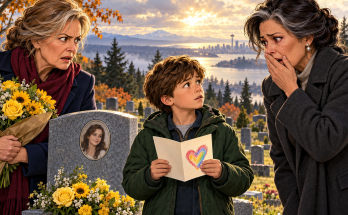
An ordinary little boy.
My little boy.
Yet this stranger was staring at him as if he had walked out of a photograph she had spent years trying to forget.
“Look at me,” I said.
Marianne turned.
“Who is his father?”
Her lips parted.
For a moment, I thought she would refuse to answer. I could already imagine her apologizing, stepping around me, disappearing down the hill with whatever she had brought to my daughter’s grave.
I moved slightly, putting myself between her and the path.
“No more silence.”
Her face crumpled.
“My son.”
The wind lifted a corner of the ribbon tied around the flowers in my hand.
I remember that ribbon with ridiculous clarity.
Yellow satin.
A little frayed where Miles had tried to cut it himself.
For ten years, I had imagined a hundred different answers to the question of his father. A boy who had moved away. A married man. Someone who had never been told. Someone who had died.
I had never imagined learning the truth from another grandmother.
“What’s his name?”
“Adrian.”
“Adrian what?”
“Vale.”
I repeated it silently.
Adrian Vale.
A name I should have heard in my kitchen ten years earlier.
A name that should have appeared on school forms instead of an empty space.
A name my daughter had carried to her grave.
“Grandma?”
Miles was close enough now that I could see the worry in his face.
Children notice when adults go still.
They may not understand the reason, but they feel the change.
I turned toward him and forced my fingers to loosen around the flowers.
“You found your card.”
He nodded.
Then he looked at Marianne.
“Are you Mom’s friend?”
Marianne made a small sound.
It was almost a laugh, except there was no happiness in it.
“I knew her,” she said.
Miles glanced at the headstone.
“Before I was born?”
“Yes.”
“Did she tell you about me?”
Marianne covered her mouth.
And suddenly I was angry in a way that frightened me.
Not loud anger.
Not the kind that makes you slam a door.
The kind that makes every thought arrive perfectly clear.
This woman knew something about my daughter.
She knew something about my grandson.
And she had chosen this morning, of all mornings, to arrive empty-handed and cry in front of him.
“Miles,” I said gently, “would you put your card beside the flowers?”
He crouched at the grave.
I stepped closer to Marianne and lowered my voice.
“Where is your son?”
She looked at me.
“Judith—”
“Where?”
“He’s nearby.”
“Nearby where?”
“At a hotel.”
My eyes moved instinctively toward the parking lot.
For one terrible second, every person in the distance looked suspicious. A man beside a blue sedan. Someone walking a dog beyond the cemetery fence. A figure standing near the chapel.
“Is he watching us?”
“No.”
“Are you sure?”
“Yes. He isn’t here.”
“You had better be telling me the truth.”
“I am.”
Miles smoothed his card against the base of the headstone.
He had drawn Lena with long yellow hair because he had run out of brown markers. Beside her, he had drawn himself holding a baseball glove.
Underneath, in careful block letters, he had written:
HAPPY BIRTHDAY, MOM.
I WISH YOU COULD COME TO MY GAMES.
Marianne saw it.
Her face folded with grief.
I wanted to ask her whether she had any idea how many moments like that she had missed.
Then I realized missing them had been her choice.
Living through them without answers had been ours.
“I brought something,” she whispered.
She opened her handbag.
I watched her hands.
They were shaking so badly that she struggled with the clasp.
Finally, she pulled out a cream-colored envelope.
Its edges were softened. One corner had bent and been carefully flattened again. There was a faint mark on the back, the sort left by a glass set down on paper.
Then she turned it over.
My name was written across the front.
Judith.
The cemetery seemed to tilt.
I knew that handwriting.
I knew the long downward stroke of the J.
I knew the way Lena pressed too hard with a pen, leaving tiny ridges in the paper beneath.
I had seen that handwriting on grocery lists, birthday cards, school permission slips she had tried to sign for me when she was fifteen.
For years after her death, I had been afraid I would find the last thing she had ever written.
Then I would know there was nothing new left.
No forgotten note in a coat pocket.
No message tucked inside a book.
No more words from my daughter waiting somewhere in the world.
And now this woman was holding an envelope with my name on it.
“Where did you get that?”
“Lena gave it to me.”
I stared at her.
“When?”
“Before she went into the hospital.”
“How long before?”
“Several weeks.”
The words came slowly.
Each one seemed to cost her something.
“She asked me to give it to you if she couldn’t explain everything herself.”
I looked at the envelope again.
The flap was still sealed.
“You’ve had this since before she died?”
“Yes.”
Miles stood.
“Grandma, what’s that?”
I couldn’t answer him.
My throat had closed.
Marianne extended the envelope toward me.
I took it carefully, holding the edges as if the paper might break.
Ten years.
Ten years of birthdays.
Ten years of school photographs.
Ten years of telling a little boy I didn’t know why his father had never come.
And somewhere, this envelope had existed.
In a drawer.
In a box.
In this woman’s house.
Waiting while my grandson grew up.
“Why?” I asked.
Marianne’s eyes filled again.
“I was afraid.”
I looked at her for a long moment.
Then I glanced at Miles.
He was studying my face now, searching for something that would tell him whether he should be frightened.
So I put the envelope inside my coat.
“We’re going home,” I said.
“But we just got here.”
“I know, sweetheart.”
“Did I do something?”
The question broke through my anger.
I crouched immediately.
“No.”
His lower lip trembled.
“No, Miles. You haven’t done anything wrong.”
“Then why are you upset?”
I brushed a piece of hair away from his forehead.
“Someone has given me something important that belonged to your mom. I need to read it.”
“Is it bad?”
“I don’t know yet.”
He looked toward Marianne.
“Did you make Grandma sad?”
She drew in a shaky breath.
“Yes,” she said quietly. “I think I did.”
I stood before she could say anything else.
“You’re coming with us,” I told her.
She nodded.
I didn’t invite her because I trusted her.
I invited her because I had spent ten years without answers, and I wasn’t letting the person who held them disappear before I knew what she had done.
We walked down the hill in silence.
Miles slipped his hand into mine.
He hadn’t done that on the way up.
At the car, Marianne stopped a few feet away.
“I have my own vehicle.”
“Then follow me.”
She nodded again.
I memorized the color of her car.
Dark green.
I noticed the first three numbers on her license plate.
Grief had taught me how quickly something could leave your life.
I wasn’t taking chances with the truth.
On the drive home, Miles kept turning toward the rear window.
“Is she still behind us?”
“Yes.”
“Why does she need to come?”
“Because I have questions.”
“About Mom?”
“Yes.”
He was quiet for a while.
Then he asked, “Did Mom write you a birthday letter?”
I tightened my hands on the steering wheel.
“I don’t think so.”
“Maybe she wanted you to get it today.”
I looked at him in the mirror.
He was sitting beneath the little knitted hat I had made him the previous winter, his ears sticking out on either side.
“I don’t think she wanted me to wait this long,” I said.
At home, I hung my coat on the hook beside the door.
Then I immediately took it down again.
The letter was still inside.
For a ridiculous moment, I had been afraid to let it out of my sight.
“Miles, would you go upstairs for a little while?”
He didn’t move.
“Are you going to talk about my dad?”
Marianne had stopped in the doorway.
I turned slowly toward him.
“What makes you ask that?”
He shrugged, but his face had changed.
“People get quiet like this when I ask about him.”
I had thought I was protecting him.
Yet he had learned the shape of our silence anyway.
I crouched in front of him.
“I don’t have enough answers to tell you anything yet.”
“Does she?”
His eyes moved past my shoulder.
I could have lied.
I could have told him we were only talking about his mother.
But I had spent ten years giving him the truth I had, even when it was small and painful.
I wasn’t going to stop now.
“She says she knows something.”
His breath caught.
“His name?”
“Possibly.”
“You know it?”
“I’ve been told a name.”
“What is it?”
I glanced toward Marianne.
Then back at him.
“I need to make sure what I’m being told is true.”
“But you can tell me.”
“Miles—”
“What if I already know him?”
The question stopped me.
His mind was moving much faster than I had understood.
He was thinking about teachers.
Neighbors.
Men in the grocery store.
Every adult who had ever smiled at him.
“No one is going to surprise you with a meeting,” I said. “I promise you that.”
He searched my face.
“Will you tell me after?”
“When I know what I can tell you honestly, we’ll sit down together.”
He looked disappointed.
Worse than disappointed.
He looked used to it.
Then he nodded.
“Okay.”
He walked upstairs without another question.
I waited until I heard his bedroom door close.
Only then did I turn toward Marianne.
“Sit down.”
She sat at my kitchen table.
The same table where Lena had told me she was pregnant.
There was a small pale circle near Marianne’s elbow where Lena had once set a hot pan without using a trivet.
I had considered refinishing it after her death.
I never did.
Now this stranger rested her hands beside that mark, and I could barely stand the sight of her there.
“Before I open this,” I said, “you need to understand something.”
She lifted her eyes.
“If you came here because you want something from Miles, you should leave.”
“I didn’t.”
“If your son thinks he can send his mother ahead and then arrive with some story about his rights—”
“He doesn’t.”
“You don’t know what I’m going to say.”
“No,” she answered. “But I know what he asked me to do.”
“And what was that?”
“Give you the letter. Answer your questions. Let you decide whether you ever wanted to speak to him.”
I studied her.
“Why couldn’t he bring it himself?”
She looked down at her clasped hands.
“He said the first promise that needed keeping wasn’t his.”
I didn’t know what to do with that answer.
So I pulled out the chair across from her.
I sat down.
The refrigerator hummed behind me.
Upstairs, something rolled across Miles’s floor. One of his toy cars, probably.
Life continued making its small familiar noises while I slid my finger beneath the flap of an envelope my daughter had sealed ten years earlier.
The paper tore slightly.
I flinched.
Marianne reached toward me, then stopped before her hand crossed the middle of the table.
Inside were several folded pages.
I lifted them out.
A faint blue line ran across the top of the first sheet.
Lena had used paper from the cheap notebooks I used to buy in packs of three.
For a moment, I could almost see her.
Sitting cross-legged on her bed.
Chewing the end of her pen.
Pushing her hair behind her ear as she tried to decide how to begin.
My eyes blurred.
I blinked until the words became clear.
Mom,
If Marianne is giving you this, then either I lost my nerve, or something happened before I could explain everything myself.
I stopped breathing.
I read the line again.
Then I looked across the table.
“She knew something could happen.”
Marianne’s face tightened.
“She was worried.”
“And she told you?”
“She was frightened of leaving things unfinished.”
I pressed the heel of my hand against my mouth.
My daughter had been afraid.
She had been carrying fear inside her, along with my grandson, and I had been standing in the kitchen asking whether she needed more milk.
I made myself look back at the page.
Please read all of this before you decide what kind of man Adrian is.
I know that sounds like I’m asking you to forgive someone you haven’t even met.
I’m not.
I’m asking you to know the whole story first.
My fingers tightened.
Then I reached the next lines.
Miles’s father is Adrian Vale.
He knows about the baby.
He wanted to be here.
And before you decide he abandoned us, you need to know what really happened.
I lowered the letter.
“Where was he when she died?”
Marianne’s eyes filled.
“At a treatment facility in Vermont.”
“For what?”
“He was very ill.”
“How ill?”
She took a breath.
“He had suffered a psychiatric crisis. He needed care we couldn’t give him at home.”
I sat back slowly.
The anger inside me shifted, searching for somewhere to land.
“Did he know she was in the hospital?”
“Not while it was happening.”
“Did he know she died?”
“Yes.”
“Then why didn’t he come for his son?”
Marianne closed her eyes.
For the first time since the cemetery, she looked as though she might be sick.
“Judith,” she whispered, “there’s something you need to read before I answer that.”
I looked down again.
Lena’s handwriting grew tighter halfway down the page.
Adrian’s father has been telling him one thing and telling me another.
His name is Conrad Vale.
I need you to remember that name.
I stopped.
The kitchen suddenly felt too small.
I looked across the table at Marianne.
“What did your husband do?”
She opened her eyes.
And this time, she didn’t look away.